
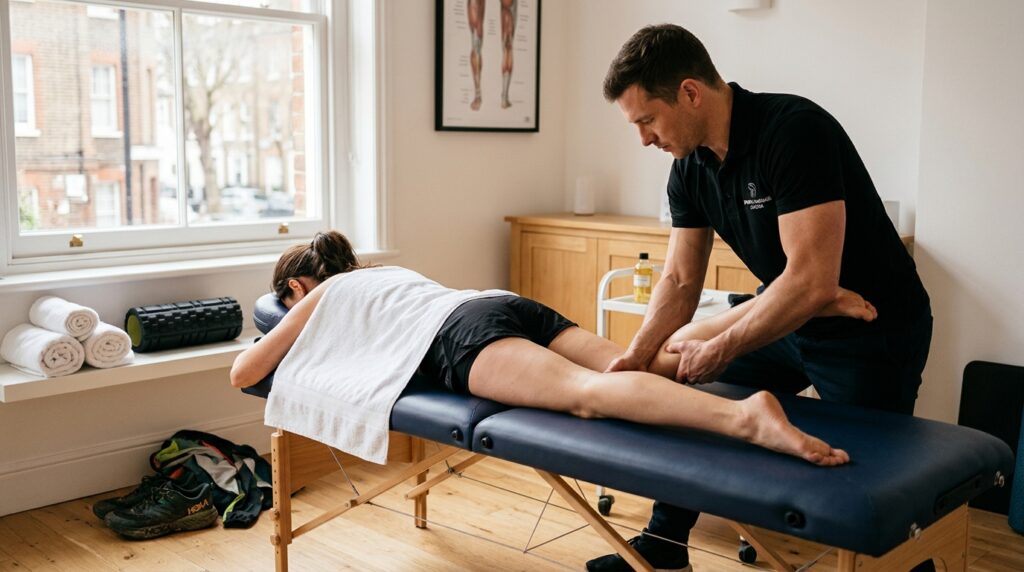
Sports massage benefits go well beyond feeling good on the couch: done well, it eases post-training soreness, restores movement in tight muscles and helps you spot small problems before they become injuries. If you have been searching for sports massage near me around the City and Docklands, this guide explains what the treatment actually does, what the research supports, how it differs from a normal massage, and when it is worth booking.
What Is Sports Massage?
Sports massage is a targeted soft tissue treatment designed around how you train, move and recover. Unlike a relaxation massage, which follows a set routine, a sports massage session starts with questions about your activity, any niggles and your goals, then focuses on the muscle groups doing the most work.
Techniques Your Therapist May Use
- Effleurage: long, flowing strokes that warm tissue and increase circulation
- Petrissage: kneading and lifting to loosen dense muscle
- Deep stripping: slow, firm pressure along the length of a muscle
- Trigger point release: sustained pressure on tight, tender spots
- Cross-fibre friction: short strokes across a tendon or scar tissue
- Soft tissue release and assisted stretching: combining pressure with movement to restore range
Pressure is adjusted throughout. A good therapist works firmly enough to make a change, but never to the point where you tense up against them.
Sports Massage Benefits for Recovery
Recovery is where the evidence for massage is strongest.
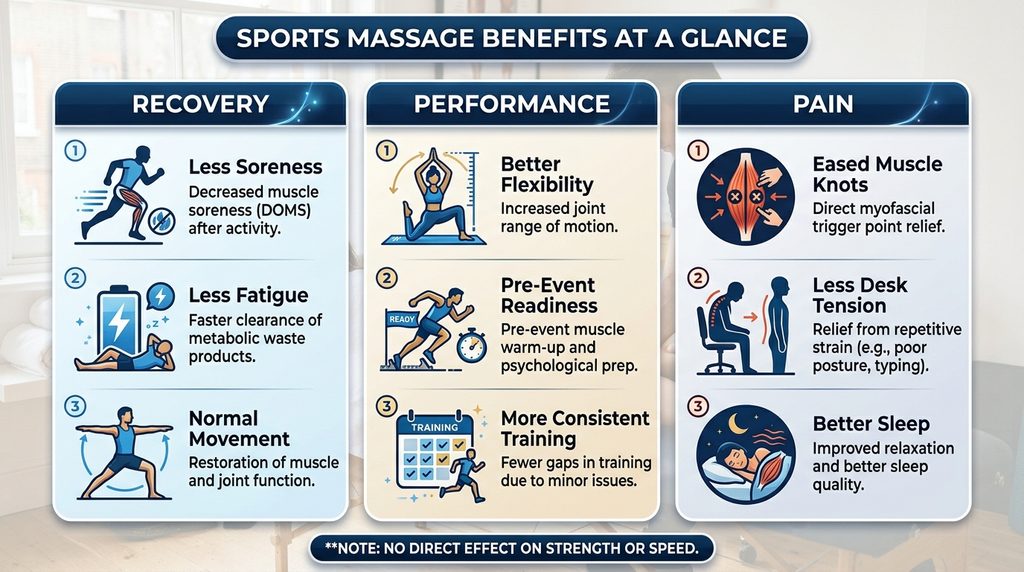
Less Post-Exercise Soreness
Delayed onset muscle soreness (DOMS) peaks 24 to 72 hours after hard or unfamiliar training. A meta-analysis of post-exercise recovery techniques published in Frontiers in Physiology compared massage with methods including cold water immersion, compression garments and stretching, and found massage was the most effective for reducing DOMS and perceived fatigue.
Feeling Fresher Between Sessions
The same review found small reductions in markers of muscle damage and inflammation after massage. In practice, athletes describe legs that feel lighter and less “heavy”, which makes the next session easier to start and complete.
Faster Return to Normal Movement
Stiff, sore muscles change how you move, and compensation patterns are where overuse injuries often begin. Easing soreness early helps you keep moving normally rather than guarding.
Sports Massage Benefits for Performance
This is where we are careful to separate what massage does from what it is often claimed to do.
Improved Flexibility and Range of Motion
A systematic review in BMJ Open Sport and Exercise Medicine, covering 29 studies and over 1,000 participants, found massage produced small but significant improvements in flexibility. For a runner with tight calves or a lifter struggling to reach depth in a squat, small gains in range can make training feel noticeably smoother.
Pre-Event Preparation
A short, brisk pre-event massage can help you feel warm, loose and mentally ready. It should complement your warm-up, not replace it. Pre-event work is quicker and lighter than a recovery session, with more movement and less sustained pressure, so muscles feel responsive rather than heavy.
What Massage Does Not Do
The same BMJ review found no evidence that massage directly improves strength, sprint speed, jump height or endurance. Its performance value comes indirectly: better recovery means more consistent, higher-quality training.
Sports Massage Benefits for Pain and Everyday Tension
Easing Muscle Tightness and Trigger Points
Tight bands and tender knots in muscles are among the most common reasons people book. Sustained pressure and stretching reduce tone in overactive muscles and usually ease local pain within a session or two.
Desk-Related Neck and Shoulder Tension
You do not need to play sport to benefit. Long screen days load the upper back and neck, and sports massage is one of the most requested treatments among office workers who come to us with neck pain and tight shoulders.
Lower Stress and Better Sleep
Massage shifts the nervous system towards its “rest and digest” state. Many patients tell us they sleep better on the night of a session, which matters, because sleep is when most tissue repair happens.
What the Research Says
Massage is surrounded by bold claims, so here is how the main ones stack up against current evidence. We use this table with patients to set honest expectations from the first session.
| Claimed benefit | Strength of evidence | What it means for you |
|---|---|---|
| Reduced DOMS | Good, multiple meta-analyses | Book within 48 hours of hard sessions or races |
| Reduced perceived fatigue | Moderate | Helps during heavy training blocks |
| Improved flexibility | Moderate, small effect | Pair with regular mobility work |
| Strength, speed, endurance | No direct effect found | Value comes through better recovery |
| Injury prevention | Limited direct research | Useful for spotting early tightness and imbalance |
Sports Massage vs Regular Massage
People often ask whether a sports massage is different from a normal massage. The short answer is yes, in purpose, assessment and technique.
| Sports massage | Deep tissue massage | Relaxation massage | |
|---|---|---|---|
| Main goal | Recovery, mobility, training support | Chronic tension and adhesions | Stress relief and wellbeing |
| Assessment | Training history and problem areas | Areas of long-standing tightness | Usually none |
| Pressure | Varies, firm where needed | Consistently deep and slow | Light to medium |
| Includes stretching | Often | Sometimes | Rarely |
In reality, most massage therapy sports massage sessions blend techniques. Our guide to sports massage vs deep tissue massage explains that comparison in more detail.
When to Book: Before, After or In Between
| Timing | Style | Purpose |
|---|---|---|
| 1 to 2 days before an event | Light to moderate, brisk | Feel loose without leaving muscles sore |
| 24 to 72 hours after | Gentle, flushing strokes | Ease soreness and stiffness |
| During regular training | Firmer, targeted | Maintain mobility, catch niggles early |
Avoid deep work the day before a race. If you are building towards a long event, our article on marathon recovery covers how to plan the weeks after.
Who Benefits Most
- Runners and cyclists with repetitive load through calves, hamstrings, quads and hips
- Gym-goers and CrossFit athletes managing heavy, high-volume training
- Football, rugby and racquet players recovering from contact and quick changes of direction
- Office workers with stiff necks, shoulders and lower backs from long desk days
- Anyone returning to exercise after a break, when soreness is most intense
Is Sports Massage Safe?
For most people, yes. Some temporary soreness for a day or two is normal after firm work. We postpone or adapt treatment if you have:
- A fresh injury from the last 48 to 72 hours with swelling or bruising
- A fever, infection or skin condition in the area
- A suspected blood clot, or you take blood-thinning medication (tell your therapist)
- A recent fracture, or unexplained calf pain and swelling
If pain is sharp, linked to a specific incident or not improving, it needs assessment rather than massage alone. Our approach to sports injury starts with diagnosis, so treatment matches the problem.
A Typical Clinical Picture
A composite example drawn from common presentations, not a single patient’s story.
Presentation: A 34-year-old who works in the City is training for a spring half marathon, running four times a week, with calves that feel tight for days after long runs and a dull ache on the outside of the knee.
Assessment: Dense, tender calves, tight outer thigh tissue and reduced ankle movement. No joint swelling or signs of structural injury.
Plan: Fortnightly sessions focusing on calves, hamstrings and hips, with soft tissue release and assisted stretching, plus a short daily calf and hip mobility routine. Sessions are timed two days after long runs and moved earlier in race week, with a light pre-event treatment.
How to Choose the Best Sports Massage in London
The best sports massage comes from a therapist who assesses before treating, explains what they find and adjusts pressure as they go. Look for:
- Recognised training, ideally a Level 4 or Level 5 qualification in sports massage
- Voluntary registration with the Complementary and Natural Healthcare Council or membership of a professional body
- Access to other clinicians if massage alone is not enough
At London Wellness, our sports massage London service sits alongside chiropractic and physiotherapy, so you can be referred within the same team when needed. You can meet our massage therapists and clinicians and read what our patients say before booking. Our clinics hold a 4.9 average rating across more than 300 patient reviews.
We provide Canary Wharf sports massage from our Port East Building clinic. If you are looking for sports massage in the City of London, Canary Wharf is a short Elizabeth line, Jubilee line or DLR journey from Bank, Liverpool Street and Farringdon.
Frequently Asked Questions
-
Is a sports massage different from a normal massage?
Yes. A normal relaxation massage follows a set sequence with light to medium pressure, aiming to help you unwind. A sports massage begins with questions about your training and problem areas, then targets the muscles under most load using firmer techniques, trigger point work and assisted stretching. It is designed to support recovery and movement, so pressure and focus change from session to session depending on what your body needs.
-
How often should I get a sports massage?
It depends on your training load. During heavy training blocks or race preparation, every one to two weeks works well for most people. For general maintenance, every three to four weeks is usually enough. Office workers with recurring neck and shoulder tension often do well with monthly sessions. Your therapist can suggest a schedule after the first appointment, based on how your muscles respond and how quickly tightness returns.
-
Does sports massage hurt?
It can feel intense in tight areas, but it should never be unbearable. A useful guide is a “good discomfort” of around 6 or 7 out of 10, where you can still breathe and stay relaxed. If you find yourself tensing or holding your breath, tell your therapist so they can adjust. Mild soreness for a day or two afterwards is normal, similar to the feeling after a training session.
-
Should I have a sports massage before or after exercise?
Both can be useful, but the style differs. Before an event, a short, brisk massage one to two days ahead helps you feel loose without leaving muscles sore. After hard training or a race, a gentler session within 24 to 72 hours eases soreness and stiffness. Avoid deep, firm work the day before competition, as it can leave muscles feeling heavy rather than fresh.
-
How long do the benefits of sports massage last?
Reduced soreness and improved flexibility are usually felt for several days after a session. The benefits build when massage is part of a routine that includes stretching, strength work, sleep and sensible training load. Massage alone will not hold changes for long if the cause of tightness, such as long hours at a desk or a sudden jump in mileage, carries on unchanged. Regular sessions maintain progress more effectively.
-
Can sports massage help if I don’t play sport?
Absolutely. Despite the name, many of our sports massage patients are office workers dealing with stiff necks, tight shoulders and lower back tension from long desk days and commuting. The same techniques that help athletes recover also ease muscle tightness caused by posture and stress. Sessions are tailored to your daily routine rather than a sport, with practical advice on desk set-up and simple stretches to use between appointments.
Book a Sports Massage
If tight muscles are holding back your training or your working week, our team can assess what is going on and tailor each session to your goals.
- Phone: 020 7531 4444
- Email: info@thisislondonwellness.com
- Canary Wharf (sports massage, physiotherapy and chiropractic): Port East Building, 14 Hertsmere Rd, London E14 4AF
- Monument (chiropractic): The Light Centre, 36 St Mary at Hill, London EC3R 8DU
Recovery is part of training, and the right hands make every session count.