
If you have been searching for shockwave therapy near me because a tendon problem refuses to settle, you are not alone. Shockwave therapy has become one of the most widely used treatments for stubborn tendon and soft tissue pain, yet many people book it without a clear idea of what it involves. This guide explains what shockwave therapy is, how it works inside the tissue, which conditions it helps, what a session feels like and how it compares with other options.
What Is Shockwave Therapy?
Shockwave therapy, known clinically as extracorporeal shockwave therapy or ESWT, is a non-invasive treatment that delivers short, high-energy acoustic pulses into injured tissue through the skin. “Extracorporeal” simply means the energy is generated outside the body. There are no needles, no incisions and no injections.
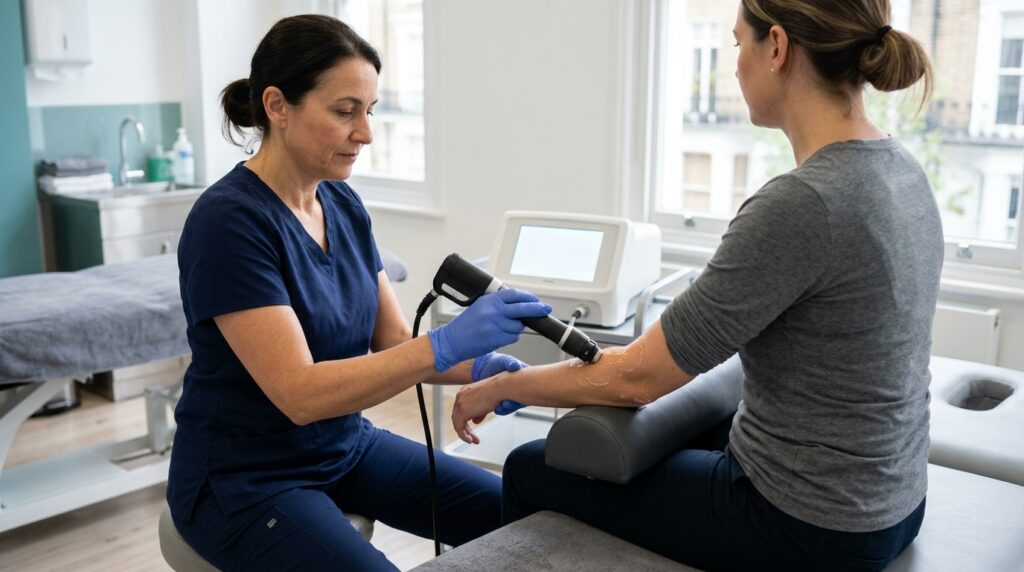
The pulses are delivered through a handheld applicator placed over the painful area, with a layer of gel to carry the energy into the tissue. A typical session lasts around 10 to 15 minutes, and most people walk out and return to work the same day.
From Kidney Stones to Tendons
The technology was first used in the early 1980s to break up kidney stones without surgery, a procedure called lithotripsy. Clinicians noticed that the surrounding tissue and bone responded to the energy as well, and through the 1990s orthopaedic and sports medicine teams began applying lower-energy versions to chronic tendon conditions. Today it is a routine part of musculoskeletal care in private clinics and many NHS services.
Who Delivers Shockwave Therapy
In the UK, shockwave is usually delivered by physiotherapists, chiropractors, podiatrists and sports medicine doctors who have been trained in the equipment and in tendon assessment. The machine is only part of the picture. Diagnosis, dosage and the rehabilitation that follows matter just as much as the device itself.
How Shockwave Therapy Works
Chronic tendon problems are not simply inflammation. Over months, the tendon’s repair process stalls, collagen fibres become disorganised and the area becomes more sensitive. Shockwave therapy works by restarting that stalled process.
Turning Pressure Into Repair
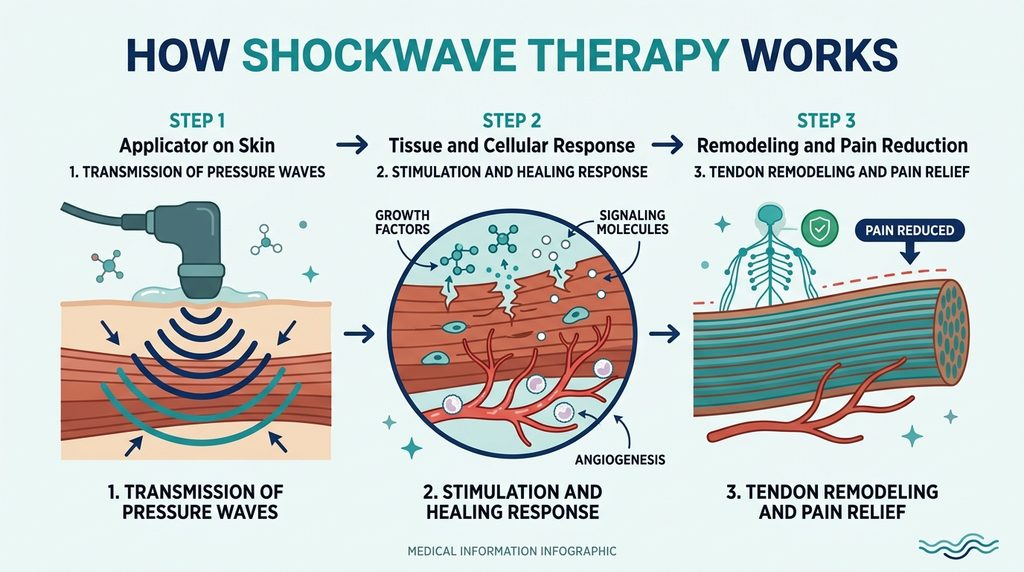
Tendon cells respond to mechanical load. This process, called mechanotransduction, is why exercise strengthens tendons. Shockwave pulses act as a concentrated mechanical stimulus, prompting cells to release growth factors that encourage new blood vessel formation and fresh collagen production. In effect, the treatment nudges a chronic injury back into an active healing phase.
Breaking the Pain Cycle
Shockwave also changes how pain is signalled. The pulses appear to reduce levels of pain-related chemicals in the tissue and overstimulate local nerve endings, which dampens the signals they send. This is why some patients notice reduced pain soon after a session, even though the deeper tissue repair takes several weeks.
Breaking Down Calcium Deposits
In some shoulder problems, calcium builds up inside the rotator cuff tendons. Higher-energy shockwave can help fragment these deposits so the body can gradually reabsorb them, easing pain and improving movement.
Inside a Shockwave Therapy Machine: Radial vs Focused
Not every shockwave therapy machine works the same way. There are two main types, and the right choice depends on the depth and nature of the problem.
Radial Shockwave
Radial devices use compressed air to fire a small projectile against the applicator head. The energy spreads outwards like ripples and is strongest at the skin surface, making it well suited to tendons and muscles lying close to the surface, such as the outer elbow, Achilles tendon and heel.
Focused Shockwave
Focused devices generate the wave electromagnetically, electrically or with piezoelectric crystals and concentrate it on a precise point at a set depth. This makes them useful for deeper structures and for calcific shoulder tendinopathy, where accuracy matters.
| Feature | Radial Shockwave | Focused Shockwave |
|---|---|---|
| How energy is produced | Compressed air projectile | Electromagnetic, piezoelectric or electrohydraulic |
| Energy pattern | Spreads outwards, strongest at surface | Converges on a focal point |
| Treatment depth | Superficial structures | Deeper structures |
| Common uses | Tennis elbow, Achilles, plantar heel pain | Calcific shoulder, deep hip and knee tendons |
| Sensation | Rapid tapping across a wider area | Sharper, more localised intensity |
What Does Shockwave Therapy Treat?
Shockwave therapy is best suited to chronic tendon and soft tissue conditions that have lasted three months or more and have not responded fully to rest, exercise or manual therapy.
| Condition | Area Affected | How Shockwave Helps |
|---|---|---|
| Achilles tendinopathy | Back of heel and lower calf | Stimulates tendon repair, reduces pain |
| Plantar fasciitis | Underside of heel | Eases morning heel pain |
| Tennis elbow | Outer elbow and forearm | Reduces grip pain |
| Golfer’s elbow | Inner elbow | Reduces tendon sensitivity |
| Patellar tendinopathy | Front of knee | Supports return to jumping and running |
| Calcific shoulder tendinopathy | Rotator cuff | Helps break down calcium deposits |
| Greater trochanteric pain | Outer hip | Eases pain lying on the side |
| Shin splints | Front of lower leg | Reduces bone and soft tissue stress pain |
Tendon Problems in the Legs and Feet
Lower limb tendons take a huge load during walking and running, so they are some of the most common areas we treat. Our guide to shockwave therapy for Achilles tendon pain covers that condition in detail. Shockwave is also used for front-of-knee pain in runners and jumpers as part of our patellar tendon and knee pain care, and for stubborn shin and leg pain linked to overuse. Plantar heel pain often benefits from combining shockwave with footwear and loading advice from a podiatrist Canary Wharf patients can see in the same building.
Elbow and Shoulder Tendon Pain
Tennis elbow is one of the strongest indications for shockwave, particularly when symptoms have lasted longer than six months. It is a regular part of our tennis elbow treatment pathway alongside progressive forearm strengthening. In the shoulder, shockwave is mainly used for calcific tendinopathy, where imaging confirms a calcium deposit.
Who Is Not Suitable for Shockwave
Shockwave is not appropriate for everyone. Your clinician will avoid or delay treatment if you:
- Are pregnant
- Are under 18
- Have had a steroid injection into the same area in the last three months
- Have an infection, open wound or tumour at the treatment site
- Have a tendon tear or rupture
- Take blood-thinning medication or have a bleeding disorder
- Are currently taking fluoroquinolone antibiotics
- Have a pacemaker or metal implant near the treatment area
What to Expect From Shockwave Treatment
Your First Assessment
Every course starts with a full assessment by a member of our clinical team. We take a detailed history, examine the area, test strength and movement and check for anything that needs onward referral or imaging. If shockwave is suitable, we explain the plan and how it fits with your rehabilitation.
During a Session
Gel is applied to the skin and the applicator is moved over the painful area. You will hear a rapid clicking and feel a tapping or pulsing sensation. Over the most sensitive spots it can feel intense, usually rated moderate on a pain scale, but the intensity can be adjusted throughout. Most sessions take 10 to 15 minutes.
After a Session
The area may feel tender, warm or slightly red for a day or two. Bruising and temporary numbness are possible but uncommon. Most people return to normal daily activity straight away.
How Many Sessions You Need
Most patients need three to six sessions spaced about a week apart. Some notice change after two or three, but tendon remodelling continues for weeks after the final session, so the full benefit is often clearer around 8 to 12 weeks later.
| Timeframe | What Most Patients Notice |
|---|---|
| During session | Tapping or pulsing, intense over sore spots |
| 24 to 48 hours | Mild soreness, sometimes reduced pain |
| After 2 to 3 sessions | Easier daily activity, less morning stiffness |
| 6 to 12 weeks after course | Ongoing improvement as tendon remodels |
Shockwave Therapy vs Other Treatments
Shockwave works best as part of a combined plan rather than a standalone fix. Here is how it compares with other common options for chronic tendon pain.
| Treatment | Approach | Main Strength | Main Limitation |
|---|---|---|---|
| Shockwave therapy | Acoustic pulses stimulate repair | Non-invasive, targets chronic stalled healing | Needs several sessions |
| Exercise rehabilitation | Progressive tendon loading | Strongest long-term evidence | Slow if pain limits loading |
| Steroid injection | Anti-inflammatory medication | Fast short-term relief | Higher recurrence, may weaken tendon |
| Massage therapy | Hands-on soft tissue work | Eases muscle tension | Limited effect on tendon structure |
| Surgery | Tendon debridement or repair | Option when all else fails | Longer recovery, surgical risk |
If you are weighing hands-on options, our comparison of sports massage vs deep tissue massage explains how massage can support muscles around an irritated tendon.
What the Evidence Says
Research on shockwave is extensive but varies by condition, device and dose. NICE has issued guidance on extracorporeal shockwave therapy for refractory tennis elbow and for refractory plantar fasciitis, which allows its use with clear patient consent and ongoing audit because study results are not always consistent. NHS hospitals also offer it, and the Bradford Teaching Hospitals patient guide sets out typical sessions, side effects and aftercare that closely match our own approach.
The clearest message from the evidence is that shockwave performs best when it is combined with progressive exercise, rather than used on its own.
Case Study: Tennis Elbow in a Keen Padel Player (Illustrative)
This is a composite example based on presentations commonly seen in our clinics, not a single identifiable patient.
Presentation: A 44-year-old project manager playing padel three times a week developed outer elbow pain that had lasted eight months. Lifting a coffee cup and gripping a laptop bag were painful, and rest had not helped.
Assessment findings:
- Pain on resisted wrist extension and gripping
- Reduced grip strength on the affected side
- No signs of nerve involvement or joint problems
Plan: Five weekly radial shockwave sessions, progressive forearm and shoulder strengthening, and a temporary reduction in padel with a gradual return.
Outcome: Grip pain eased noticeably by the third session. Six weeks after the final session, the patient was back to full matches with only occasional mild stiffness.
Aftercare: Getting the Best Results
- Avoid anti-inflammatory medication such as ibuprofen during the course, as it may blunt the healing response. Check with your GP if you take it for another condition.
- Skip ice on the treated area unless your clinician advises otherwise.
- Avoid heavy or pain-provoking activity for 48 hours after each session.
- Keep up your exercises. Loading the tendon is what turns the healing stimulus into stronger tissue.
- Contact the clinic if pain increases significantly or you notice swelling that does not settle.
Shockwave Therapy London: Where to Get Treatment
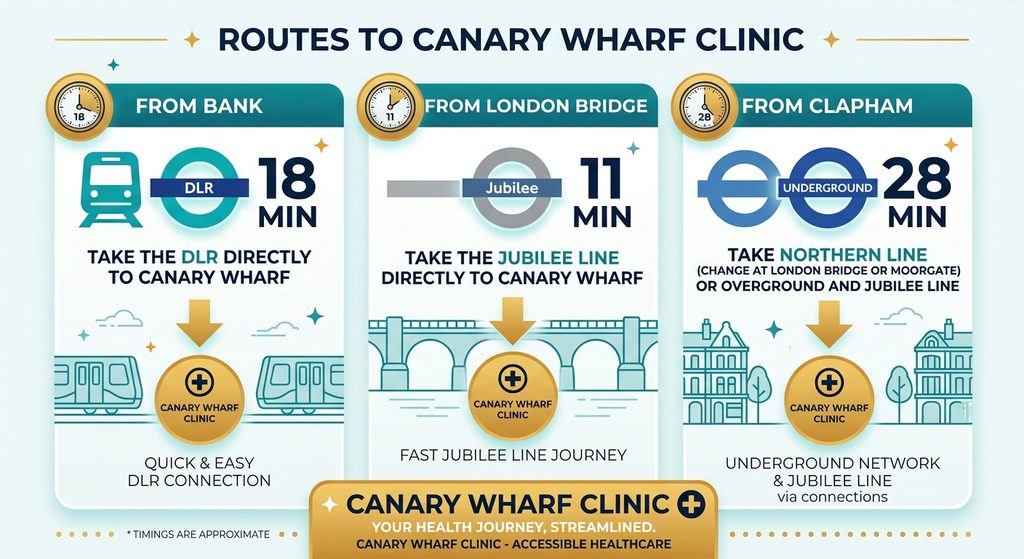
Our shockwave therapy London service runs at our Canary Wharf clinic in the Port East Building, close to West India Quay DLR and Canary Wharf station.
Many people searching for shockwave therapy Monument work in the City. Bank station connects directly to the DLR, so Canary Wharf is a short journey from the Square Mile. Patients searching for shockwave Clapham can reach us by taking the Northern line to London Bridge and changing to the Jubilee line. Wherever you are coming from, booking shockwave London appointments starts with an assessment so we can confirm the treatment is right for you.
Many private health policies cover assessment and treatment, so check our shockwave therapy with Bupa or AXA cover page for the insurers we work with.
Book a Shockwave Assessment
If a tendon problem has lasted months and is affecting your work, training or sleep, our team can assess whether shockwave therapy is the right next step. Call, email or contact our team to arrange an appointment.
Phone: 020 7531 4444 Email: info@thisislondonwellness.com
London Wellness Canary Wharf Port East Building, 14 Hertsmere Rd, London E14 4AF, United Kingdom
London Wellness Monument The Light Centre, 36 St Mary at Hill, London EC3R 8DU, United Kingdom
Frequently Asked Questions
-
What is shockwave therapy used for?
Shockwave therapy is used for chronic tendon and soft tissue problems that have not improved with rest, exercise or manual therapy. Common examples include Achilles tendinopathy, plantar fasciitis, tennis elbow, patellar tendinopathy, outer hip pain and calcific shoulder tendinopathy. It works by restarting the body’s natural healing process in tissue where repair has stalled, and it is most effective when combined with a structured exercise programme guided by your clinician.
-
Does shockwave therapy hurt?
Shockwave therapy can feel uncomfortable, especially over the most sensitive part of the tendon, but it is rarely described as severe. Most people feel a strong tapping or pulsing that eases as the session goes on. Your clinician adjusts the intensity to keep it tolerable. Afterwards the area may feel tender for a day or two, similar to a bruise, and most people return to normal activities straight away.
-
How many shockwave therapy sessions will I need?
Most people need between three and six sessions, usually spaced about a week apart. Some notice reduced pain after two or three sessions, while long-standing problems may need the full course. Because the tendon continues to remodel after treatment ends, improvement often keeps building for 8 to 12 weeks after the final session. Your clinician will review your progress at each visit and adjust the plan accordingly.
-
Is extracorporeal shockwave therapy safe?
Extracorporeal shockwave therapy is considered safe when delivered by a trained clinician after a proper assessment. Side effects are usually minor, such as temporary soreness, redness, bruising or numbness that settles within a week. It is not suitable during pregnancy, over an infection, tumour or tendon rupture, or within three months of a steroid injection to the same area. Your clinician will screen for these before starting treatment.
-
What is the difference between radial and focused shockwave therapy?
Radial shockwave spreads energy outwards from the applicator and is strongest near the skin, which suits superficial tendons such as the outer elbow, Achilles and heel. Focused shockwave concentrates energy on a precise point at a set depth, making it useful for deeper structures and calcific shoulder problems. Both stimulate tissue repair. The right choice depends on the condition, its depth and how it has responded to previous treatment.
-
Where can I get shockwave therapy near me in London?
London Wellness offers shockwave therapy at our Canary Wharf clinic in the Port East Building on Hertsmere Road. It is easy to reach from the City via the DLR from Bank, and from south London via the Jubilee line from London Bridge. Every course begins with a full assessment to confirm shockwave is suitable for your condition. Call 020 7531 4444 or email info@thisislondonwellness.com to book your first appointment.
A tendon that has been stuck for months is not a tendon that cannot heal. With the right stimulus and the right rehabilitation, most people get back to the things they enjoy.