
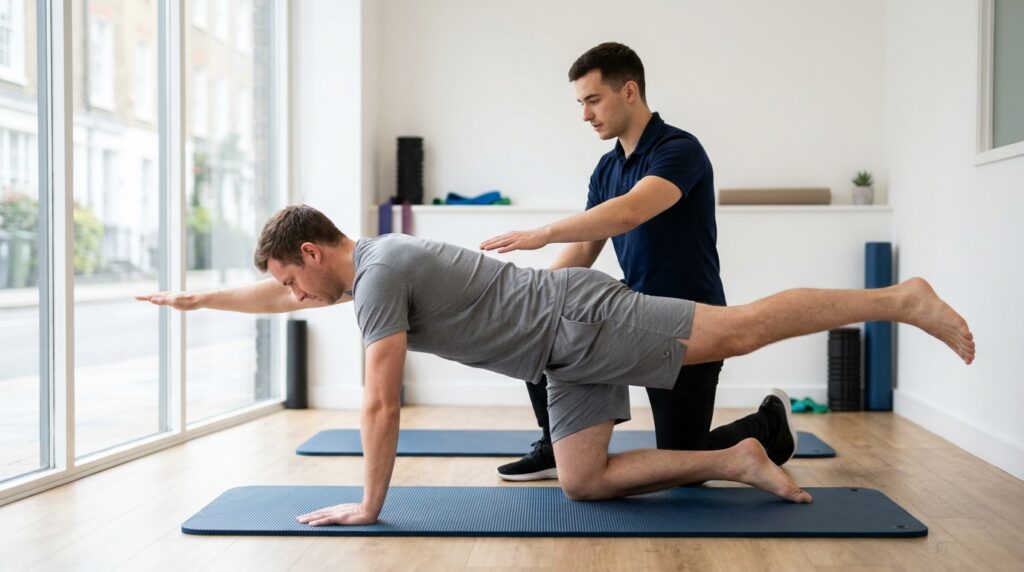
The right exercises for lower back pain do more than ease today’s ache: they build the support your spine needs to stop the same pain coming back next month. If you have been searching for back pain treatment near me in Canary Wharf or the City, start here: these are the ten movements our physiotherapists prescribe most often, in the order we usually teach them, with the cues we give in clinic and a simple plan to progress them safely.
Why Core Strength Matters for Lower Back Pain
Most lower back pain is “non-specific”, meaning no single damaged structure explains it. What we usually find on assessment is a spine that is stiff in some places, overloaded in others, and short of muscular support.
What the Core Actually Is
Your core is not just your six-pack. It is a cylinder of muscles: the diaphragm on top, the pelvic floor underneath, the deep abdominals (transversus abdominis) wrapping the front and sides, and the multifidus and erector spinae running along the spine. The glutes and obliques connect it to your hips and ribs. When this system works together, load spreads evenly instead of piling onto a few lumbar joints. That is why we train people to strengthen core muscles as a team, not with endless crunches.
What the Evidence Says
Exercise is the first-line treatment for lower back pain in UK guidance. NICE guideline NG59 recommends exercise in its various forms, and only supports manual therapy as part of a package that includes exercise. A Cochrane review of exercise therapy for chronic low back pain, covering more than 240 trials, found moderate-certainty evidence that exercise reduces pain compared with no treatment or usual care. No single exercise type stood out, which is why we focus on movements you will actually keep doing.
Before You Start: Five Safety Rules
- Use a pain scale. Mild discomfort up to 3 out of 10 is acceptable during exercise if it settles within 24 hours. Sharp or worsening pain means stop.
- Start small. Begin with exercises 1 to 4, then add the rest over two to three weeks.
- Breathe throughout. Holding your breath stiffens the trunk and raises pressure through the spine.
- Quality over quantity. Five controlled reps beat fifteen rushed ones.
- Get assessed if symptoms run down the leg. People with a herniated disc often need a modified programme.
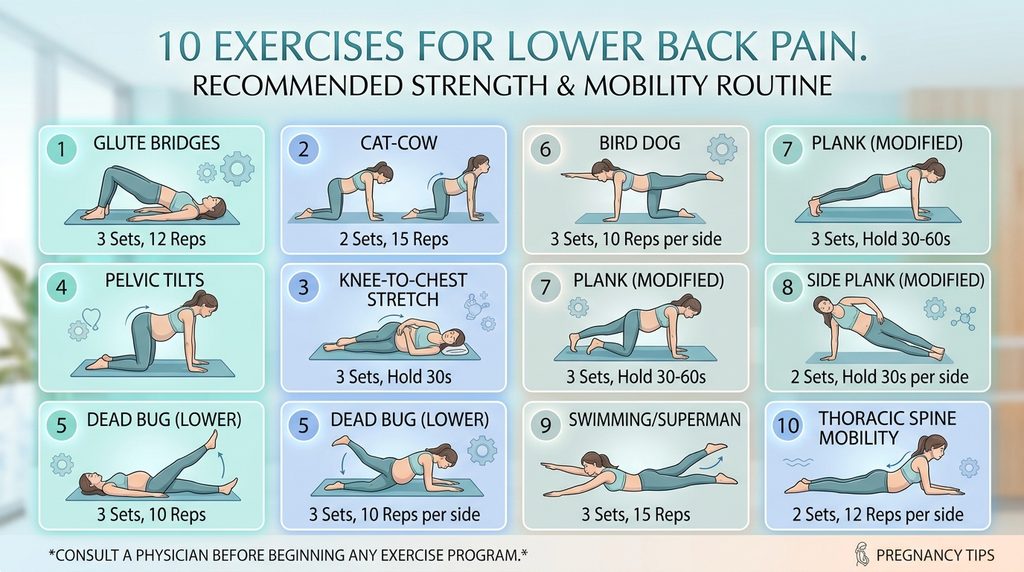
10 Physio-Approved Exercises for Lower Back Pain
1. Diaphragmatic Breathing with Core Bracing
Lie on your back with knees bent. Breathe into your lower ribs and belly so both expand, then breathe out slowly while gently drawing your lower tummy towards your spine, about 20 percent effort. Reps: 8 breaths, twice daily. Physio tip: your back should stay still; if it flattens hard into the floor, you are squeezing too much.
2. Pelvic Tilts
In the same position, gently rock your pelvis to flatten your lower back into the floor, then tilt the other way to create a small arch. Move slowly through a comfortable range. Reps: 10 to 15. Physio tip: this is a mobility drill, not a strength test, so keep your glutes relaxed.
3. Single Knee-to-Chest Stretch
Lying on your back, hug one knee towards your chest while the other foot stays on the floor. Hold 20 to 30 seconds and switch. Reps: 3 per side. Physio tip: pull from behind the thigh rather than over the kneecap if your knees are sensitive.
4. Cat-Cow
On hands and knees, slowly round your spine towards the ceiling, then let it sag gently as you lift your chest. Reps: 10 slow cycles. Physio tip: move segment by segment, starting from the tailbone, to restore movement through stiff areas.
5. Glute Bridge
Lie on your back, knees bent, feet hip-width apart. Brace lightly, press through your heels and lift your hips until your body forms a straight line from shoulders to knees. Hold 3 seconds, lower slowly. Reps: 2 sets of 10. Physio tip: if you feel it in your hamstrings, walk your feet closer to your hips.
6. Bird Dog
On hands and knees, extend your right arm and left leg until they line up with your back. Hold 5 seconds without rotating your hips, return and switch. Reps: 2 sets of 8 per side. Physio tip: imagine a cup of tea balanced on your lower back.
7. Dead Bug
Lie on your back with arms reaching up and hips and knees bent to 90 degrees. Lower the opposite arm and leg towards the floor while keeping your lower back still, then return. Reps: 2 sets of 8 per side. Physio tip: only lower as far as you can without your back arching.
8. Modified Side Plank
Lie on your side, propped on your forearm with knees bent. Lift your hips so your body forms a line from head to knees. Hold 15 to 20 seconds. Reps: 3 per side. Physio tip: this targets the quadratus lumborum and obliques, which stabilise the spine side to side. Progress to straight legs when 30 seconds feels easy.
9. McGill Curl-Up
Lie on your back with one knee bent and one leg straight, hands under the curve of your lower back. Lift your head and shoulders a few centimetres, hold 8 to 10 seconds, lower. Reps: 5 to 6, switching legs halfway. Physio tip: this builds abdominal endurance without the repeated spinal bending of a traditional sit-up.
10. Half-Kneeling Hip Flexor Stretch
Kneel on one knee with the other foot in front. Tuck your pelvis under and shift forward until you feel a stretch at the front of the back hip. Hold 30 seconds. Reps: 3 per side. Physio tip: tight hip flexors from long hours of sitting pull the pelvis forward and load the lower back, so this one matters for desk workers.
A Simple Four-Week Progression
| Phase | Exercises | Frequency | Goal |
|---|---|---|---|
| Weeks 1 to 2 | 1, 2, 3, 4 | Daily | Calm pain, restore movement |
| Weeks 3 to 4 | Add 5, 6, 10 | 5 days a week | Build glute and trunk control |
| Week 5 onwards | Add 7, 8, 9 | 3 to 4 days a week | Endurance and back pain relief that lasts |
Pair the programme with 20 to 30 minutes of walking most days. Gentle aerobic activity improves blood flow to spinal tissues and reduces pain sensitivity.
Stretching, Strengthening or Pilates?
| Approach | What it does | Best for |
|---|---|---|
| Stretching | Restores range of movement | Stiffness, long periods of sitting |
| Core strengthening | Builds spinal support and endurance | Recurring pain, returning to sport or gym |
| Aerobic exercise | Improves fitness and pain tolerance | Long-standing pain, low activity levels |
| Pilates or yoga | Combines control, breathing and flexibility | People who prefer guided classes |
A balanced programme uses all four. If you have been told to avoid exercise, our article on common back pain myths explains why rest alone usually slows recovery.
Common Mistakes We See in Clinic
- Holding your breath during bridges and planks
- Arching the lower back during dead bugs and bird dogs
- Doing too much in week one, then stopping when pain flares
- Stretching only, without building strength
- Stopping once pain eases, which is when recurrence risk is highest
Desk Workers: Small Changes That Help
Long days at a City or Docklands desk are a common driver of lower back pain in London. Stand and move for a minute or two every 30 minutes, set your screen at eye level and keep your feet flat. Our guide to back care tips at the desk and on the commute covers workstation set-up in more detail.
Red Flags: When to Get Checked First
Stop exercising and seek medical advice if your back pain comes with any of the following. The NHS back pain guidance lists these as reasons for urgent help:
- Numbness, tingling or weakness in both legs
- Numbness around the genitals or bottom
- New problems controlling your bladder or bowels
- Fever, feeling unwell or unexplained weight loss
- Pain after a serious fall or accident, or pain that is worse at night and does not ease with rest
A Typical Clinical Picture
A composite example drawn from common presentations, not a single patient’s story.
Presentation: A 38-year-old analyst in Canary Wharf with a dull ache across the lower back after long screen days, worse on the commute, with occasional flare-ups after weekend gym sessions.
Assessment: Stiff lumbar segments, tight hip flexors, weak glutes and poor trunk endurance on side plank testing. No nerve signs or red flags.
Plan: Two weeks of mobility and breathing work (exercises 1 to 4), then glute and stability progressions, a desk movement routine and a gradual return to deadlifts with technique coaching. Progress is tracked with plank endurance times and pain levels at the end of the working day.
When Exercise Is Not Enough: Back Pain Treatment in London
If pain has not improved after four to six weeks, keeps returning or limits work and sleep, a hands-on assessment will show what is holding you back. Our physiotherapists offer back pain treatment in London built around a personalised exercise programme, with manual therapy where it helps. For stiff joints, our chiropractors may add spinal manipulation alongside your exercises, in line with NICE guidance.
We see patients with back pain in Canary Wharf, where physiotherapy and chiropractic are both available, and offer chiropractic care at Monument. Find out more about how we assess and treat back pain in London. Our clinics hold a 4.9 average rating across more than 300 patient reviews, and we are registered with major private medical insurers including AXA PPP and Bupa.
Frequently Asked Questions
-
How often should I do exercises for lower back pain?
Start with gentle mobility exercises daily for the first one to two weeks, then move to strengthening work four to five days a week. Once pain has settled, three to four sessions a week maintains core strength and lowers the chance of recurrence. Short, regular sessions of 10 to 15 minutes work better than one long weekly workout because your muscles adapt to frequent, consistent loading rather than occasional effort.
-
How long does it take for core exercises to help back pain?
Many people notice less stiffness within one to two weeks, mainly from improved movement and reduced muscle guarding. Measurable strength gains usually take six to eight weeks of consistent training, and endurance keeps improving for three months or more. If you see no change at all after four weeks, or pain is getting worse, book an assessment so a physiotherapist can check whether the programme suits your problem.
-
Should I exercise if my back hurts?
In most cases, yes. Gentle movement speeds recovery from non-specific lower back pain, while prolonged bed rest tends to increase stiffness and slow it down. Keep pain during exercise at or below 3 out of 10 and make sure it settles within 24 hours. Stop and seek advice if pain is sharp, spreads down your leg, or comes with numbness, weakness or changes in bladder or bowel control.
-
What exercises should I avoid with lower back pain?
During a flare-up, avoid traditional sit-ups, heavy deadlifts, toe-touch stretches with straight legs and high-impact running. These load the spine in flexion or under fatigue before it has the support to cope. They are not banned forever: most people return to them once core strength improves. A physiotherapist can show you how to reintroduce them gradually with the right technique and load.
-
Is walking good for lower back pain?
Walking is one of the most useful things you can do. It keeps the spine moving, improves circulation to spinal discs and muscles, and reduces pain sensitivity without heavy loading. Start with 10 to 15 minutes on flat ground and build towards 30 minutes most days. Supportive footwear and a relaxed arm swing help, and walking pairs well with the core exercises in this guide.
-
Can core exercises prevent back pain coming back?
They help, especially when you keep them up. Recurrence is common after a first episode of lower back pain, and people who keep exercising after their pain settles tend to have fewer and milder flare-ups. The key is continuing a maintenance routine of three to four sessions a week rather than stopping once you feel better. Combining core work with regular walking and movement breaks during desk work gives the best protection.
Book a Back Pain Assessment
If you want a programme tailored to your back, your job and your training, our team can assess what is driving your pain and show you exactly which exercises to prioritise.
- Phone: 020 7531 4444
- Email: info@thisislondonwellness.com
- Canary Wharf: Port East Building, 14 Hertsmere Rd, London E14 4AF
- Monument: The Light Centre, 36 St Mary at Hill, London EC3R 8DU
You can also get in touch with our team to ask which clinician and location suit you best.
A stronger core is built a few minutes at a time, and every session moves your back in the right direction.