
If you have been searching for a wellness centre near me that offers dry needling in London, you have probably noticed two things: lots of clinics mention it, and very few explain clearly what it does. This guide sets out the dry needling benefits our clinicians see in practice, how the technique works on muscle and nerve tissue, what it actually feels like on the couch, and where it overlaps with, and differs from, acupuncture.
What Is Dry Needling?
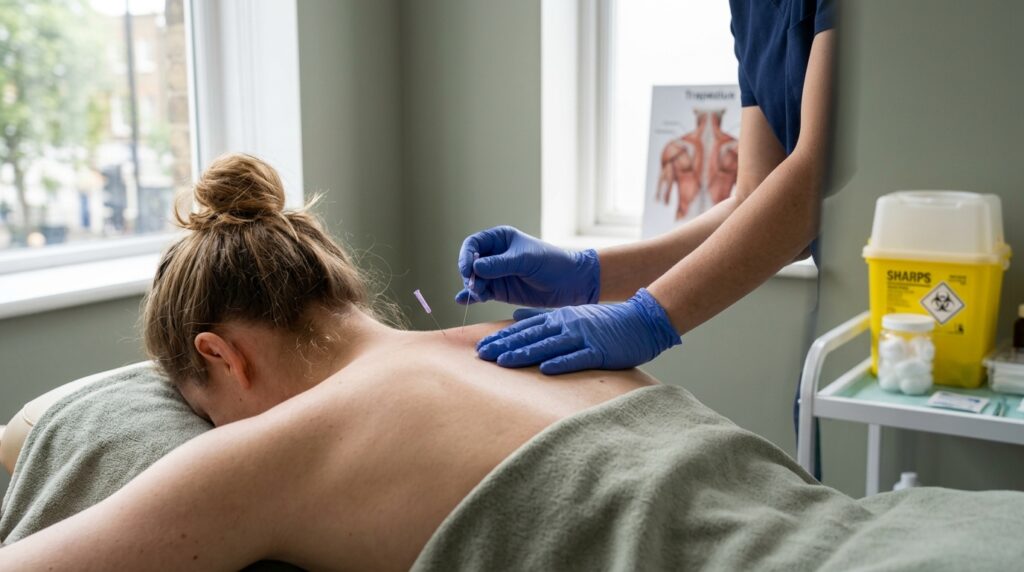
Dry needling is a treatment in which a trained clinician inserts a very fine, solid, single-use needle into a tight, sensitive area of muscle. The word “dry” simply means nothing is injected. The needle itself is the treatment.
It is used as part of a wider plan for musculoskeletal pain, not as a standalone cure. In our clinics it sits alongside hands-on therapy, joint mobilisation and exercise, because needling a sore muscle without fixing the load or posture that irritated it rarely gives lasting change.
Trigger Points: The Target of Treatment
Most dry needling is aimed at myofascial trigger points. These are small, hyperirritable spots within a taut band of muscle. You may know them as “knots”. Press on one and you often feel a deep ache, sometimes with pain travelling somewhere else. A trigger point in the upper trapezius, for example, commonly refers pain up the side of the neck and into the temple.
Trigger points can be active, meaning they reproduce your familiar pain, or latent, meaning they are tender when pressed and quietly limit how well the muscle works. Both respond to needling.
Who Performs Dry Needling in the UK
In the UK, dry needling is usually delivered by chiropractors, physiotherapists and osteopaths who have completed postgraduate training in the technique. Chiropractors are regulated by the General Chiropractic Council and physiotherapists by the Health and Care Professions Council, so you know the person needling you has a recognised clinical background in anatomy and assessment. Always ask what training your practitioner has completed before your first session.
How Dry Needling Works
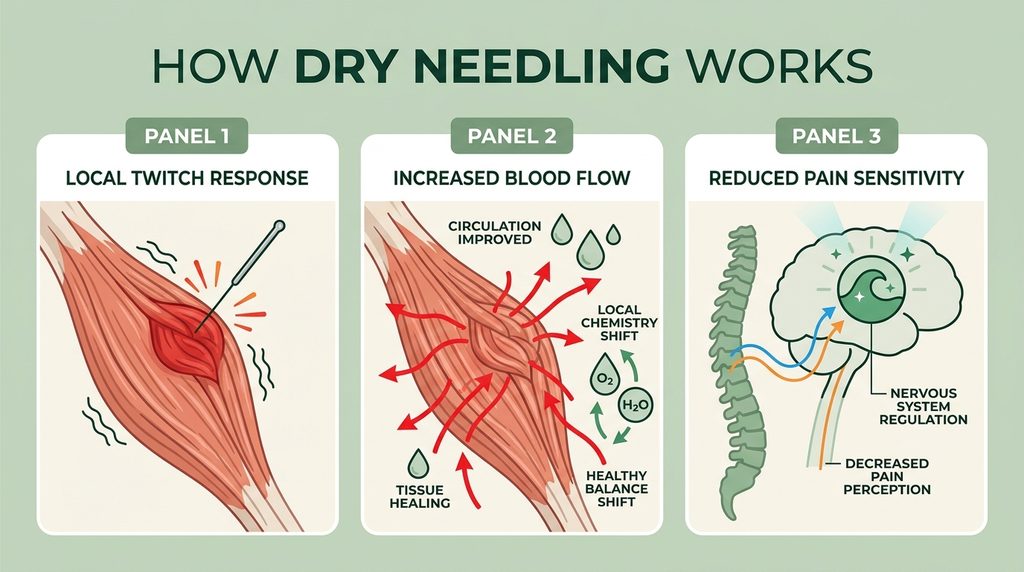
Research into the mechanisms is still developing, but three effects are well supported and match what we observe in clinic.
The Local Twitch Response
When the needle reaches an active trigger point, the muscle often gives a brief, involuntary jump called a local twitch response. It lasts a fraction of a second. Studies link this twitch to a reset of the overactive muscle fibres, and patients frequently notice the area feels softer and moves more freely straight afterwards.
Chemical and Blood Flow Changes
Laboratory work has found that active trigger points sit in a more acidic environment, with raised levels of inflammatory and pain-signalling chemicals. Needling appears to change that local chemistry and briefly increase blood flow, which helps explain why a stubborn ache can ease within a day or two of treatment.
Calming an Overactive Nervous System
Long-standing pain makes the nervous system more sensitive, so normal pressure starts to register as painful. Needling sends a strong, short sensory signal that seems to dampen this sensitivity, both at the spinal cord and higher up in the brain’s pain-processing centres. That is why benefits are not always limited to the exact spot that was needled.
The Main Dry Needling Benefits
Based on current evidence and our own clinical experience, the most consistent dry needling benefits are:
- Faster pain relief in tight muscles. Many patients report a noticeable drop in pain within 24 to 48 hours.
- Better range of movement. Releasing a guarded muscle often lets a stiff neck turn further or a shoulder lift higher in the same session.
- Reduced referred pain. Treating the source trigger point can ease pain felt elsewhere, such as headaches coming from the neck.
- A window for rehabilitation. Less pain means you can do the strengthening work that prevents the problem returning.
- Precision. A needle reaches deep muscles, such as those under the shoulder blade or deep in the hip, that are hard to access with hands alone.
- Short treatment time. Needling usually takes a few minutes within a longer appointment.
Dry Needling for Migraines and Headaches
Headaches are one of the most common reasons people ask us about dry needling for migraines London. Trigger points in the upper trapezius, suboccipital muscles at the base of the skull, sternocleidomastoid and temporalis can all refer pain into the head, mimicking or aggravating migraine and tension-type headache.
Using dry needling to treat migraines in London clinics works best as part of a combined plan: needling the referring muscles, mobilising a stiff upper neck, and addressing desk posture and sleep. It is not a replacement for medical review, and any new, sudden or severe headache needs a GP assessment first. If you are unsure what type you have, our guide to the difference between migraines and headaches is a useful starting point.
Neck, Shoulder and Back Pain
City and Docklands workers spend long hours at screens, and the result shows up in the muscles of the neck and upper back. Dry needling is a core tool in our neck pain treatment London plans, particularly for the posture-driven stiffness described in our article on tech neck.
It is equally useful for rotator cuff and shoulder blade muscles. Patients seeing a shoulder pain chiropractor in Canary Wharf often have trigger points in infraspinatus that refer pain down the front of the arm. In the lower back, needling the quadratus lumborum and gluteal muscles can relieve pain that patients sometimes mistake for a disc problem.
Sports Injuries and Overuse Problems
Runners, gym users and racquet players often carry trigger points in calves, quadriceps, hip rotators and forearm extensors. Needling these areas can reduce pain and restore muscle length during recovery from a sports injury, so training can resume sooner and with better control.
| Condition | Muscles Commonly Needled | Typical Goal |
|---|---|---|
| Tension-type headache and migraine | Upper trapezius, suboccipitals, temporalis | Reduce referred head pain |
| Neck pain and stiffness | Levator scapulae, scalenes, upper trapezius | Restore rotation, ease ache |
| Shoulder pain | Infraspinatus, supraspinatus, teres minor | Reduce arm referral, improve lift |
| Lower back pain | Quadratus lumborum, gluteus medius | Ease spasm, improve bending |
| Buttock pain mimicking sciatica | Gluteus minimus, piriformis | Reduce leg referral |
| Tennis elbow | Wrist and finger extensors | Ease grip pain |
What Does Dry Needling Feel Like?
This is the question we hear most from first-time patients, so here is an honest account.
During Treatment
The needles are far thinner than those used for injections or blood tests. Most people barely feel the skin being pierced, especially when a guide tube is used. As the needle reaches the trigger point, you may feel a deep, dull ache or a brief cramp-like twitch. Some patients feel their familiar pain being reproduced, which is a useful sign the right spot has been found. The sensation fades as soon as the needle is removed.
After Treatment
Expect some muscle soreness, similar to the day after a hard workout. A small bruise is possible, and a few people feel tired for the rest of the day.
| Timeframe | What Most Patients Notice |
|---|---|
| During needling | Deep ache, brief twitch, sometimes familiar pain |
| Immediately after | Muscle feels looser, movement often easier |
| 6 to 24 hours | Mild post-needling soreness |
| 24 to 48 hours | Soreness settles, pain relief becomes clearer |
| After 2 to 4 sessions | More lasting change when combined with exercise |
Is Dry Needling Safe?
In trained hands, serious complications are rare. Your clinician will use sterile single-use needles, clean the skin, and dispose of needles in a sharps bin. Needling over the chest wall carries a small risk to the lung, which is why accurate anatomy and technique matter. Tell your clinician if you are pregnant, take blood-thinning medication, have a bleeding disorder, a needle phobia, lymphoedema, a metal allergy, or any skin infection over the treatment area. In some of these cases needling is adjusted or avoided.
Dry Needling vs Acupuncture: The Key Differences
Both treatments use the same type of fine, solid needle, which is why they are often confused. The difference lies in the reasoning behind where the needle goes and what it is meant to achieve.
| Feature | Dry Needling | Acupuncture |
|---|---|---|
| Underlying model | Western anatomy, muscle and nerve physiology | Traditional Chinese medicine, or Western medical acupuncture |
| Where needles go | Directly into trigger points in the painful muscle | Defined acupuncture points, often away from the painful area |
| Assessment | Palpation, movement testing, neurological checks | Traditional diagnosis, or a medical assessment for Western practice |
| Needle time | Seconds to a few minutes | Usually 20 to 30 minutes, left in place |
| Sensation | Deep ache and local twitch | Mild dull ache or tingling, often relaxing |
| Main uses | Muscle pain, stiffness, referred pain | Chronic pain, headache prevention, wider wellbeing |
| Typical practitioners | Chiropractors, physiotherapists, osteopaths | Acupuncturists, doctors, physiotherapists |
Acupuncture Benefits and What the Evidence Says
The acupuncture benefits with the strongest evidence relate to headache. The NICE headache guideline recommends considering a course of up to ten acupuncture sessions over five to eight weeks to prevent chronic tension-type headache, and for migraine when preventive medicines are unsuitable or ineffective. A Cochrane review on acupuncture for episodic migraine found it reduced attack frequency compared with no acupuncture, and the NIHR summary of that evidence notes results comparable to some preventive drugs. The NHS acupuncture page also lists long-term pain and migraine-type headaches among the conditions it may be offered for.
A Note on Acupuncture Prices and Value
Many people compare acupuncture prices with dry needling costs before booking. A fairer comparison looks at what each appointment includes. At London Wellness, needling is delivered within a chiropractic or physiotherapy appointment, so the same visit covers assessment, hands-on treatment, needling where appropriate and an exercise plan. For current appointment fees, please check with our reception team.
Which One Should You Choose?
Choose dry needling if your pain is clearly muscular, you can point to tight, tender areas, and you want treatment woven into rehabilitation. Consider acupuncture if you want a longer, more relaxing session aimed at headache prevention or general pain modulation. Your clinician will advise on which suits your presentation.
What to Expect at a London Wellness Appointment
Whether you found us by searching for a chiropractor near me or dry needling near me, every first visit follows the same structured process:
- Case history. We ask about your symptoms, health history, medication and goals, and screen for anything that needs medical referral.
- Physical assessment. Posture, movement, strength, neurological checks and palpation to locate active trigger points.
- Explanation and consent. We explain what we found, whether needling is suitable, and what you are likely to feel.
- Treatment. Needling is combined with manual therapy and mobilisation as clinically appropriate.
- Home plan. You leave with specific exercises and advice on workstation set-up, sleep and activity.
If you are weighing up which profession to see, our comparison of chiropractic vs physiotherapy explains how the two approaches overlap.
Case Study: Desk Worker With Weekly Headaches (Illustrative)
This is a composite example based on presentations commonly seen in our clinics, not a single identifiable patient.
Presentation: A 38-year-old financial analyst working long screen days reported headaches three to four times a week, starting at the base of the skull and spreading behind the right eye. Painkillers took the edge off but symptoms returned each afternoon.
Assessment findings:
- Reduced right neck rotation
- Active trigger points in right upper trapezius and suboccipital muscles reproducing the headache
- Forward head posture and a laptop used without a stand
Plan: Dry needling to the referring muscles, upper neck mobilisation, deep neck flexor strengthening and workstation changes, over five sessions.
Outcome: By the third visit headache days had roughly halved, and by discharge they were occasional and milder. Home exercises continued for maintenance.
Aftercare Tips to Get the Most From Dry Needling
- Keep moving. Gentle activity and the exercises you were given help the muscle adapt.
- Use heat for soreness. A warm shower or heat pack eases post-needling ache.
- Avoid heavy training of the treated muscle for a day. Light exercise is fine.
- Stay hydrated and rest well. Some people feel tired after their first session.
- Report anything unusual. Contact the clinic if you notice increasing pain, shortness of breath or signs of infection.
Dry Needling in London: Finding a Clinic Near You
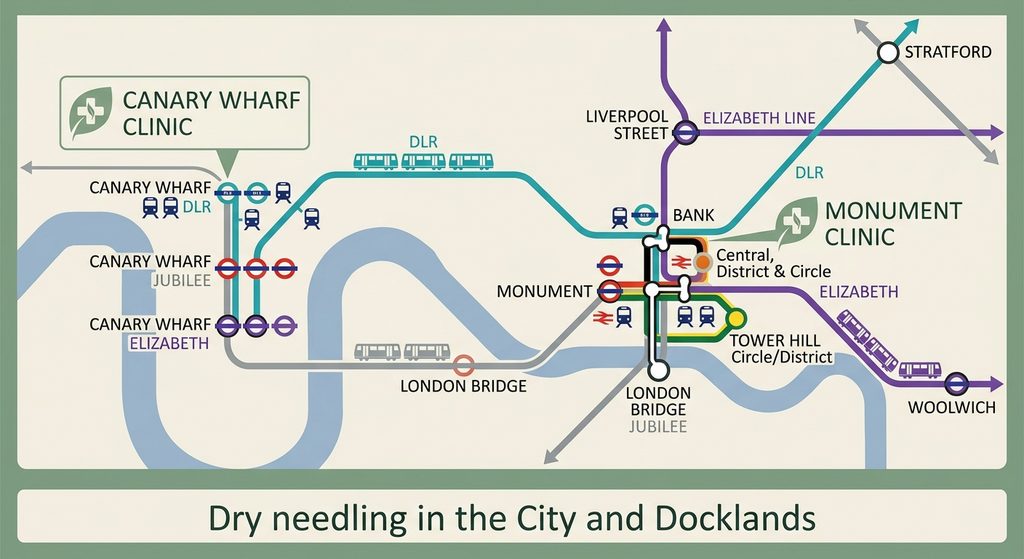
We offer dry needling across London at two locations. Patients in the City searching for dry needling Monument can be treated at our clinic on St Mary at Hill, a short walk from Monument and Bank stations. In Docklands, needling is available within physiotherapy Canary Wharf and chiropractic appointments at Port East.
Wherever you are coming from, dry needling London appointments can be booked online or by phone. Many of our patient reviews mention the difference needling made alongside their wider treatment.
Book Dry Needling at London Wellness
If tight muscles, recurring headaches or stubborn neck and back pain are holding you back, our team can assess whether dry needling is right for you. Book online or contact us directly.
Phone: 020 7531 4444 Email: info@thisislondonwellness.com
London Wellness Canary Wharf Port East Building, 14 Hertsmere Rd, London E14 4AF, United Kingdom
London Wellness Monument The Light Centre, 36 St Mary at Hill, London EC3R 8DU, United Kingdom
Frequently Asked Questions
-
What are the main dry needling benefits?
The main dry needling benefits are reduced muscle pain, improved range of movement and less referred pain, such as headaches coming from tight neck muscles. Needling can reach deep muscles that hands struggle to access, and it often brings noticeable relief within a day or two. It works best combined with manual therapy and exercise, which address the posture or loading habits that caused the muscle to tighten in the first place.
-
Does dry needling hurt?
Most patients barely feel the needle go through the skin because it is extremely fine. When it reaches a trigger point you may feel a deep ache or a brief muscle twitch lasting a split second, and sometimes your familiar pain is reproduced. Afterwards, mild soreness similar to post-exercise stiffness is common for up to 48 hours. Your clinician will check in throughout and can adjust the technique if anything feels too intense.
-
Can dry needling help migraines?
Dry needling can help when migraines or headaches are driven or aggravated by trigger points in the neck, shoulders and jaw muscles. Needling these areas can reduce how often headaches occur and how intense they feel, particularly when combined with neck mobilisation and posture changes. It does not replace medical care, so anyone with new, sudden or worsening headaches should see their GP first to rule out other causes before starting treatment.
-
Is dry needling the same as acupuncture?
No. Both use the same type of fine, solid needle, but the reasoning differs. Dry needling is based on Western anatomy and targets trigger points directly within painful muscles, usually for seconds to a few minutes. Acupuncture places needles at defined points, often away from the painful area, and they are typically left in for 20 to 30 minutes. NICE recommends acupuncture for preventing some headaches, while dry needling focuses on muscular pain.
-
How many dry needling sessions will I need?
It depends on how long you have had the problem, its cause and how well you keep up with home exercises. Many patients notice change after one or two sessions, and a typical course runs between three and six visits combined with rehabilitation. Long-standing pain may need longer. Your clinician will review progress at every appointment and will not continue needling if it is not producing measurable improvement.
-
Where can I find dry needling near me in London?
London Wellness offers dry needling at two clinics. Our Monument clinic on St Mary at Hill serves the City, Bank, Tower Hill and London Bridge. Our Canary Wharf clinic in the Port East Building serves Docklands and East London. Needling is delivered within chiropractic and physiotherapy appointments after a full assessment. You can book online, call 020 7531 4444 or email info@thisislondonwellness.com to check availability at your preferred location.
Tight muscles do not have to be a permanent part of your working week. With the right assessment, the right needle in the right place can be the turning point.