

When your back seizes up or an old injury flares, you quickly hit a fork in the road: do you book a chiropractor or a physiotherapist? Both treat pain and movement problems, both are regulated professions, and both come highly recommended, which makes the chiropractic vs physiotherapy decision genuinely confusing. The good news is that the two are less rivals than teammates, and once you understand what each does best, choosing becomes straightforward. If you are looking up your local wellness centre near me, here is a clear, balanced guide to help you decide.
The Short Answer
Both chiropractic and physiotherapy are evidence-informed, hands-on approaches to musculoskeletal health, and they overlap a great deal. The difference is one of emphasis. Chiropractic centres on the spine and joints, using manual adjustments to relieve pain, reduce stiffness and improve how the body moves. Physiotherapy centres on movement and function, using exercise alongside manual techniques to rehabilitate injuries and rebuild strength.
Put simply, chiropractic care often leans towards hands-on, practitioner-led treatment that you receive, while physiotherapy leans towards active rehabilitation that you take part in. Neither is superior. The right one depends on your problem, your goals and how you prefer to be treated.
What Is Chiropractic?
Chiropractors specialise in the spine, joints and the nervous system that runs through them. The signature technique is the adjustment, a controlled, hands-on movement applied to a joint to restore mobility and ease pain. Alongside that, a chiropractor may use soft-tissue work and give advice on posture and movement.
People most often turn to chiropractic for back pain, neck pain, sciatica, joint problems and certain headaches, particularly the tension-related kind that traces back to the neck. In the UK, chiropractic is a regulated profession: “chiropractor” is a legally protected title, and every practitioner must be registered with the General Chiropractic Council, which sets national standards for training and conduct.
A first visit is usually more about assessment than treatment. Expect questions about your history and lifestyle, followed by a physical examination of how your spine and joints move, before any hands-on work begins. Many people associate chiropractic with the audible “click” of an adjustment, but techniques vary and a good practitioner tailors them to you rather than applying the same routine to everyone.
You can read more about what treatment involves on the chiropractic treatment service page. Whatever you choose, the day-to-day habits matter too, and simple back care between appointments helps any treatment last longer.
What Is Physiotherapy?
Physiotherapy takes a broader view of movement and function across the whole body. Where chiropractic zeroes in on the spine and joints, physiotherapy is built around rehabilitation: restoring strength, mobility and normal movement after injury, surgery or illness. The core tool is tailored exercise, backed up by hands-on manual therapy, and the aim is to get you moving well again and keep you that way.
Physiotherapists treat an especially wide range, from sports injuries and post-operative recovery to long-term pain, and even areas well beyond the musculoskeletal system such as respiratory and neurological rehabilitation. It is a hands-on but active approach: you leave with exercises to do, because much of the progress happens between sessions. Like chiropractic, it is a regulated profession, and the NHS guidance on physiotherapy is a useful plain-English overview of what it covers.
That active element is worth understanding before you choose. Physiotherapy tends to reward commitment: the exercises you are given are not an afterthought, they are the treatment, and skipping them usually slows progress. For people who like to feel in control of their recovery and want tools they can keep using long after the pain has gone, that hands-on-your-own-health quality is a real strength rather than a chore.
If you are local, you can find out more on the physiotherapy in Canary Wharf service page.
Chiropractic vs Physiotherapy: The Key Differences
Laid out side by side, the distinction is much easier to grasp.
| Feature | Chiropractic | Physiotherapy |
|---|---|---|
| Main focus | Spine, joints and alignment | Movement, rehabilitation and function |
| Typical approach | Hands-on adjustments and manipulation | Exercise prescription plus manual therapy |
| Often chosen for | Back and neck pain, sciatica, headaches | Injury recovery, post-surgery, mobility |
| Your role | More passive, you receive the treatment | More active, you carry out prescribed exercises |
| UK regulator | General Chiropractic Council (GCC) | Health and Care Professions Council (HCPC) |
Which Conditions Does Each Treat?
There is a large shared middle ground here, which is exactly why people get stuck choosing. Both chiropractors and physiotherapists commonly help with back pain, neck pain, sciatica, sports injuries and posture-related strain. For these everyday complaints, either profession may be a sensible starting point.
The differences show at the edges. Chiropractic tends to be sought for joint and spinal restriction, stiffness and headaches linked to the neck. Physiotherapy tends to lead where the goal is structured rehabilitation: recovering after an operation, rebuilding after a significant injury, or managing a long-term condition through exercise. For lower back pain specifically, national clinical guidance from NICE recognises both manual therapy and exercise as part of a wider plan, which is worth knowing when you weigh up low back pain and sciatica options.
Which One Is Right for You?
Rather than asking which is better in the abstract, ask which fits your situation.
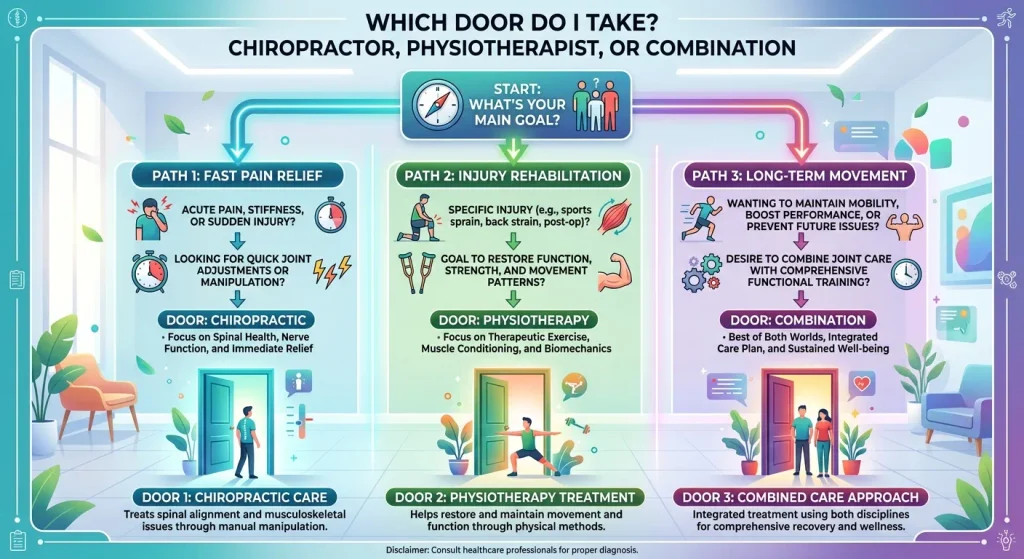
- Choose chiropractic if you want hands-on relief for spinal or joint pain, stiffness or neck-related headaches, and you like the idea of practitioner-led adjustments.
- Choose physiotherapy if you are recovering from an injury or surgery, want to rebuild strength and mobility, or prefer an active, exercise-led approach that you drive yourself.
- Consider both if your problem has more than one layer, for example pain that needs easing now and weakness that needs correcting so it does not come back.
The reassuring part is that this is rarely a permanent, either-or choice. Your body will tell you a lot, and a good clinician will point you towards the right approach after assessing you, even if that means recommending the other profession.
It is also worth being honest about your lifestyle. For the many desk-based professionals around Canary Wharf and the City, a lot of pain comes from long hours at a screen and too little movement. In that situation, hands-on treatment can bring welcome relief, but lasting change usually needs the strengthening and postural work that physiotherapy specialises in. That is precisely why so many people end up valuing both, and why an honest assessment beats guessing from a symptom on the internet.
Can You Have Both?
Yes, and for many people a combined approach delivers the best of both worlds. Chiropractic can relieve pain and free up restricted joints, while physiotherapy builds the strength and control that stop the problem returning. The two are complementary, not contradictory.
This is where a multidisciplinary clinic really helps. When chiropractors and physiotherapists work under one roof, they can coordinate your care so the treatments reinforce each other, and you are not left relaying messages between separate providers. If you do see different practitioners, it is worth making sure each knows what the other is doing so your plan stays joined up.
How to Choose a Qualified Practitioner
Whichever route you take, qualifications come first. Both titles are protected in the UK, which gives you a clear way to check. A chiropractor must be registered with the GCC, and a physiotherapist must be registered with the Health and Care Professions Council; many chartered physiotherapists also carry the letters MCSP after their name. You can search these registers by name before you book.
Beyond registration, look at experience with your particular problem, clear information about what a clinic treats, and genuine patient reviews that describe real outcomes. A practitioner who assesses you thoroughly and explains their reasoning, rather than promising to fix everything in one visit, is usually a safe pair of hands.
Book an Assessment in London
Still unsure which is right for you? The simplest next step is an assessment with a clinician who can look at your problem and recommend the best approach, chiropractic, physiotherapy or a mix of both.
You can reach our team by phone on 020 7531 4444 or by email at info@thisislondonwellness.com. Appointments are available at:
- Canary Wharf: Port East Building, 14 Hertsmere Rd, London E14 4AF
- Monument: The Light Centre, 36 St Mary at Hill, London EC3R 8DU
Frequently Asked Questions
-
What’s the main difference between chiropractic and physiotherapy?
The simplest way to put it: chiropractic focuses on the spine, joints and hands-on adjustments to relieve pain and improve movement, while physiotherapy focuses on restoring function, usually through exercise alongside manual therapy. Chiropractic care tends to be more practitioner-led and passive, whereas physiotherapy asks you to take an active role with prescribed exercises. There is significant overlap, and for many problems the two approaches complement each other rather than compete.
-
Is chiropractic or physiotherapy better for back pain?
Both can help back pain, and national guidance recognises manual therapy and exercise as valid options within a wider plan. Chiropractic may appeal if you want hands-on relief and joint-focused treatment, while physiotherapy suits you if you want to rebuild strength and address the movement patterns behind the pain. Often the best results come from combining them. The honest answer is that a proper assessment of your specific back pain matters more than the label.
-
Can I have chiropractic and physiotherapy at the same time?
Yes, and many people do. The two approaches are complementary rather than conflicting: chiropractic can ease pain and restore joint movement, while physiotherapy builds the strength and control that keep the problem from returning. In a multidisciplinary clinic, practitioners can coordinate your care so the treatments work together rather than pulling in different directions. If you are seeing separate providers, it helps to make sure each knows what the other is doing.
-
Do I need a referral for chiropractic or physiotherapy?
For private care, you usually do not need a GP referral for either, so you can book directly and be seen quickly. If you have private health insurance, check whether your insurer requires a referral first. On the NHS, physiotherapy is available but often has waiting lists, and in many areas you can self-refer to community musculoskeletal services. NHS chiropractic is limited, so most people access it privately by booking directly.
-
Which is better for a sports injury, chiropractic or physiotherapy?
Physiotherapy is often the natural first choice for sports injuries, because it centres on rehabilitation: rebuilding strength, mobility and the movement patterns needed to return to activity safely. That said, chiropractic can help where joint or spinal restriction is part of the picture. For many active people, a combined approach works best. The key is an accurate assessment of the injury first, so treatment targets the actual cause rather than just the symptoms.
-
How do I find good chiropractic or physiotherapy near me?
Start with registration: chiropractors must be registered with the GCC and physiotherapists with the HCPC, so check the relevant register before booking. Then weigh experience, the conditions they treat and genuine patient reviews. Convenience matters too if you work locally, so look for a clinic with flexible appointments. Multidisciplinary clinics that offer both under one roof are useful, since they can guide you to whichever approach fits and coordinate care if you need both.
The best treatment is not about which profession wins the debate, it is about matching the right approach to your body and your goals, so get assessed, ask questions, and choose the path that fits you.