
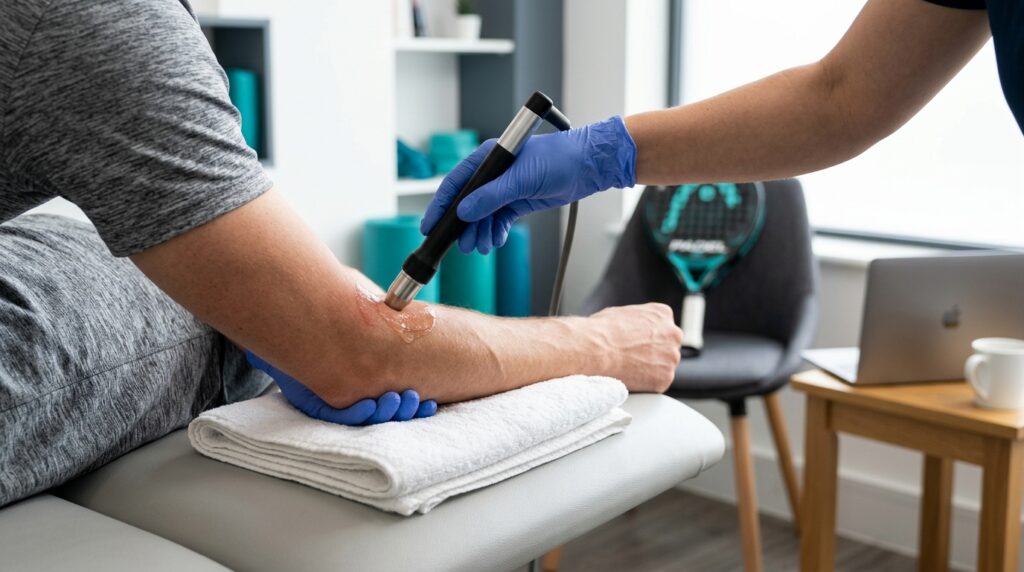
If you have been searching for a shockwave therapy for elbow pain specialist near London after months of pain on the outside of your elbow, you probably want two straight answers: does it work, and how long will it take? This guide covers what is happening inside the tendon, what the research actually shows, how many sessions most people need, what each session feels like and how shockwave compares with injections, braces and exercise alone.
What Is Tennis Elbow?
Tennis elbow, or lateral epicondylalgia, is pain where the forearm extensor tendons attach to the bony point on the outside of the elbow. The main tendon involved belongs to a muscle called extensor carpi radialis brevis, which steadies the wrist every time you grip.
Typical signs include:
- Pain on the outside of the elbow that can spread down the forearm
- Pain when gripping, lifting a kettle, turning a door handle or shaking hands
- Weaker grip on the affected side
- Tenderness over the bony point of the elbow
- Stiffness first thing in the morning
Why Office Workers Get It Too
Despite the name, only a small minority of people with tennis elbow actually play tennis. It is most common between the ages of 35 and 54 and is driven by repeated gripping and wrist extension. Long hours on a mouse and keyboard, carrying a laptop bag, DIY, gym work and racquet sports such as padel are all common triggers.
Why It Becomes Chronic
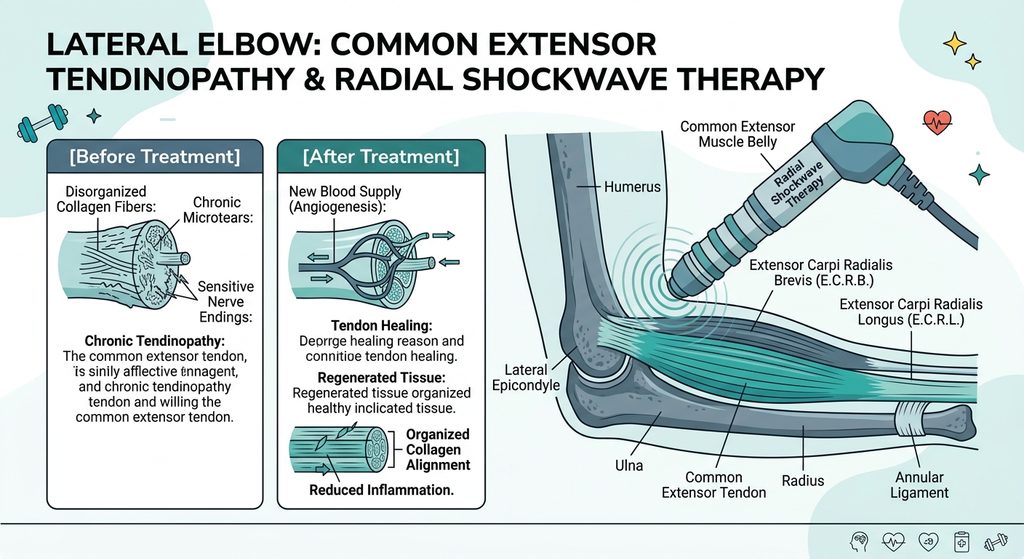
Many people search for elbow tendonitis London clinics, but in long-standing cases the problem is not mainly inflammation. The tendon has entered a failed healing state, often called tendinopathy, with disorganised collagen and increased nerve sensitivity. That is why rest, ice and anti-inflammatories often help for a while and then stop working. It is also why treatments that stimulate repair, such as progressive loading and shockwave, make sense for persistent cases.
Ruling Out Other Causes of Elbow Pain
Not all outer elbow pain is tennis elbow. Before recommending shockwave, we check for:
- Trapped or irritated nerves around the elbow, which can cause burning nerve pain into the forearm
- Pain referred from a pinched nerve in the neck
- Arthritis or other elbow joint pain inside the joint itself
- A partial tendon tear, which may need imaging
Getting this right matters, because shockwave will not help a problem that is coming from somewhere else.
How Shockwave Therapy Works for Tennis Elbow
Shockwave therapy, or extracorporeal shockwave therapy (ESWT), sends short, high-energy acoustic pulses through the skin into the tendon via a handheld applicator. There are no needles and no injections.
What Happens Inside the Tendon
The pulses act as a strong mechanical stimulus. Tendon cells respond by releasing growth factors that encourage new blood supply and fresh collagen production, effectively nudging a stalled injury back into an active repair phase. At the same time, the pulses reduce the sensitivity of local nerve endings, which is why some patients notice less pain soon after a session.
Radial or Focused: Which Is Used for the Elbow?
The common extensor tendon sits close to the skin, so radial shockwave, which spreads energy outwards and is strongest near the surface, is the type most often used for tennis elbow. Focused shockwave, which concentrates energy at a set depth, is generally reserved for deeper structures. Your clinician will choose the settings based on your assessment.
Does Shockwave Therapy Work for Tennis Elbow?
The honest answer is that it works well for many people, but not everyone, and the evidence has changed over time.
An older Cochrane review on shock wave therapy for lateral elbow pain, published in 2005, concluded that shockwave added little benefit. Many of the trials it included used early devices, single sessions and no rehabilitation. More recent research paints a more positive picture. A 2020 systematic review and meta-analysis found that shockwave reduced pain and improved grip strength in lateral epicondylitis compared with control treatments. NICE has published interventional procedures guidance allowing shockwave for refractory tennis elbow with clear patient consent and audit, recognising that results vary between studies.
| Evidence Point | What It Suggests |
|---|---|
| Early trials, single sessions, no exercise | Limited benefit |
| Modern protocols, several weekly sessions | Better pain and grip outcomes |
| Shockwave combined with tendon loading | Strongest real-world results |
| Steroid injection comparison trials | Injections act faster but relapse more often |
Who Responds Best
In our experience, shockwave therapy for tennis elbow works best for people who:
- Have had symptoms for three months or longer
- Have not improved with rest, bracing or simple exercises
- Have pain clearly located at the tendon attachment
- Are willing to follow a strengthening programme alongside treatment
When Shockwave Is Unlikely to Help
Shockwave is less likely to help when pain is coming from a nerve or the neck, when there is a significant tendon tear, or when the activity that caused the problem continues unchanged. It is also not suitable during pregnancy, within three months of a steroid injection into the same area, over broken skin or infection, or for anyone under 18.
How Many Sessions Will You Need?
Most people need three to five sessions of shockwave therapy for tennis elbow, spaced roughly a week apart. Each session takes around 10 to 15 minutes. Some patients notice change after two sessions, while long-standing cases may need the full course.
The tendon keeps remodelling after the last session, so the full benefit is usually clearer 8 to 12 weeks after treatment ends.
| Stage | Typical Timing | What Most Patients Notice |
|---|---|---|
| Session 1 | Week 1 | Intense tapping over sore spot, tenderness for 1 to 2 days |
| Sessions 2 to 3 | Weeks 2 to 3 | Easier gripping, less morning stiffness |
| Sessions 4 to 5 | Weeks 4 to 5 | Sessions feel more comfortable as sensitivity drops |
| Follow-up | 6 to 12 weeks after course | Continued gains in strength and pain |
What Affects the Number of Sessions
- How long you have had symptoms. Pain lasting over a year often needs the full course.
- Previous steroid injections. Repeated injections can leave the tendon weaker and slower to respond.
- Workload. Heavy daily gripping without changes slows progress.
- Exercise consistency. Patients who do their loading programme recover faster.
What to Expect at Each Session
Before Your First Session
Your clinician will take a full history and examine your elbow, wrist, shoulder and neck. Avoid anti-inflammatory tablets such as ibuprofen during the course, as they may dull the healing response. Let us know if you take blood thinners, have had a recent steroid injection or have a pacemaker.
During Treatment
Gel is applied over the outer elbow and the applicator is moved across the tender area. You will hear a rapid clicking and feel firm tapping. Over the most sensitive spot it can feel intense, but the intensity is increased gradually and can be reduced at any point.
After Treatment
The elbow may feel tender, warm or slightly red for a day or two. Avoid heavy gripping or pain-provoking activity for 48 hours, and avoid icing the area unless your clinician advises it. Most people return to work straight away.
Shockwave vs Other Tennis Elbow Treatments
| Treatment | Main Benefit | Main Drawback | Best Used For |
|---|---|---|---|
| Shockwave therapy | Non-invasive, stimulates repair | Several sessions needed | Persistent cases over 3 months |
| Exercise rehabilitation | Strongest long-term evidence | Slow if pain limits loading | Almost everyone |
| Steroid injection | Fast short-term relief | Higher relapse rates at one year | Rarely, short-term pain control |
| Forearm brace | Cheap, reduces strain | Does not fix the tendon | Symptom relief during activity |
| Massage and manual therapy | Eases forearm muscle tension | Limited effect on tendon structure | Supporting other treatment |
| Surgery | Option when all else fails | Recovery time, surgical risk | Cases lasting 6 to 12 months or more |
Large trials comparing steroid injections with physiotherapy found that injections gave quicker early relief, but people who had them were more likely to have pain return within a year. That is why we generally favour combining shockwave with exercise led by a tennis elbow physiotherapist London patients can see in the same clinic. Soft tissue work through sports massage in Canary Wharf can also help ease tight forearm muscles during recovery.
Exercises That Help Shockwave Work Better
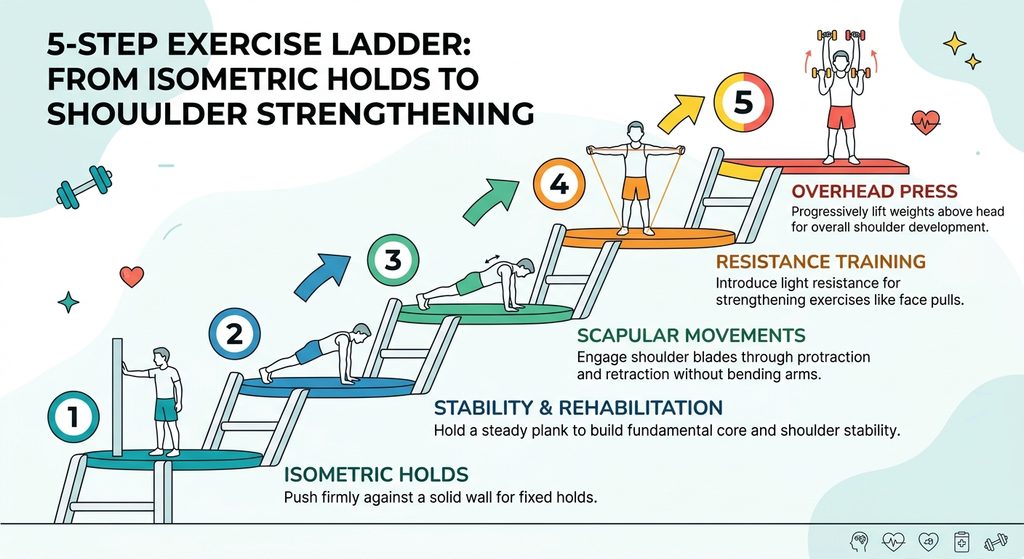
Shockwave starts the repair process, but loading the tendon is what makes it stronger. A typical programme progresses through these stages:
- Isometric holds. Holding a light weight with the wrist extended, without moving, to reduce pain.
- Slow wrist extension. Lifting and lowering a light dumbbell slowly through the full range.
- Grip strengthening. Squeezing a soft ball or putty, building up resistance over weeks.
- Forearm rotation. Turning a hammer or light bar palm up and palm down.
- Shoulder and upper back strength. Reducing the load the forearm takes during daily tasks.
Your clinician will set the starting level and progress it based on how your elbow responds.
Case Study: Software Developer With Persistent Elbow Pain (Illustrative)
This is a composite example based on presentations commonly seen in our clinics, not a single identifiable patient.
Presentation: A 41-year-old software developer had outer elbow pain on the mouse hand for ten months. One steroid injection had helped for six weeks before the pain returned. Gripping a coffee mug and typing for long periods were painful.
Assessment findings:
- Pain on resisted wrist and middle finger extension
- Grip strength reduced on the affected side
- Neck and nerve tests clear
- Laptop used without a separate keyboard or mouse
Plan: Four weekly radial shockwave sessions, a progressive forearm and shoulder loading programme, and workstation changes including an external keyboard and vertical mouse.
Outcome: Morning stiffness eased by the second session. By eight weeks after the final session, the patient could work full days and lift weights at the gym with only occasional mild discomfort.
Tennis Elbow Treatment in London: Where to Go
Our tennis elbow treatment London service, including shockwave and physiotherapy, is based at our Canary Wharf clinic in the Port East Building, close to West India Quay DLR and Canary Wharf station.
Many people search for tennis elbow physiotherapy Monument or shockwave physiotherapy Monument because they work in the City. Bank station connects directly to the DLR, making Canary Wharf a short journey from the Square Mile. Our Monument clinic focuses on chiropractic care and can help if neck or upper back problems are contributing to your arm pain.
If you live south of the river, Backspace Clapham, our partner clinic, offers chiropractic and sports massage, which can support tennis elbow treatment Clapham patients want closer to home. For anyone searching for shockwave therapy Clapham, our nearest shockwave service is at Canary Wharf, reached by the Northern line to London Bridge and the Jubilee line.
Book a Tennis Elbow Assessment
If elbow pain has lasted more than a few weeks or keeps coming back, our team can confirm the diagnosis and tell you whether shockwave therapy is likely to help.
Phone: 020 7531 4444 Email: info@thisislondonwellness.com
London Wellness Canary Wharf Port East Building, 14 Hertsmere Rd, London E14 4AF, United Kingdom
London Wellness Monument The Light Centre, 36 St Mary at Hill, London EC3R 8DU, United Kingdom
Frequently Asked Questions
-
Does shockwave therapy work for tennis elbow?
Shockwave therapy works well for many people with tennis elbow, particularly when symptoms have lasted more than three months and simpler treatments have not helped. Modern research shows improvements in pain and grip strength, especially when shockwave is combined with a progressive exercise programme. It is less effective when pain comes from a nerve, the neck or a significant tendon tear, which is why a thorough assessment before treatment is essential.
-
How many shockwave sessions do you need for tennis elbow?
Most people need three to five sessions, spaced about a week apart, with each session lasting around 10 to 15 minutes. Some notice improvement after two sessions, while long-standing cases or those with previous steroid injections may need the full course. Because the tendon keeps healing after treatment ends, your clinician will usually review your progress 6 to 12 weeks after the final session before deciding on anything further.
-
Does shockwave therapy for tennis elbow hurt?
Shockwave can feel uncomfortable over the most tender part of the tendon, often described as a firm, rapid tapping. Your clinician starts at a low intensity and increases it gradually, adjusting it to keep treatment tolerable. Discomfort usually eases as the session continues and tends to reduce with each visit as sensitivity drops. The elbow may feel tender for a day or two afterwards, similar to a bruise.
-
How long does shockwave take to work for tennis elbow?
Some people notice less pain within a few days of their first or second session, but the main benefit builds gradually. Tendon remodelling continues for weeks after the course ends, so most patients see the clearest improvement 8 to 12 weeks after their final session. Keeping up with strengthening exercises during and after treatment makes a significant difference to how quickly and how fully the elbow recovers.
-
Is shockwave better than a steroid injection for tennis elbow?
Steroid injections often reduce pain faster in the short term, but research shows people who have them are more likely to see pain return within a year, and repeated injections can weaken the tendon. Shockwave works more slowly but aims to stimulate genuine tendon repair. For persistent tennis elbow, many clinicians now prefer shockwave combined with exercise rather than injections, although the right choice depends on your individual situation.
-
Where can I get tennis elbow treatment near me in London?
London Wellness provides tennis elbow assessment, physiotherapy and shockwave therapy at our Canary Wharf clinic in the Port East Building on Hertsmere Road. It is easy to reach from the City via the DLR from Bank and from south London via the Jubilee line. Every course begins with a full assessment to confirm the diagnosis and the right plan. Call 020 7531 4444 or email info@thisislondonwellness.com to arrange your first appointment.
Tennis elbow can feel endless, but a stuck tendon is not a broken one. The right stimulus, the right exercises and a little patience get most people gripping comfortably again.