
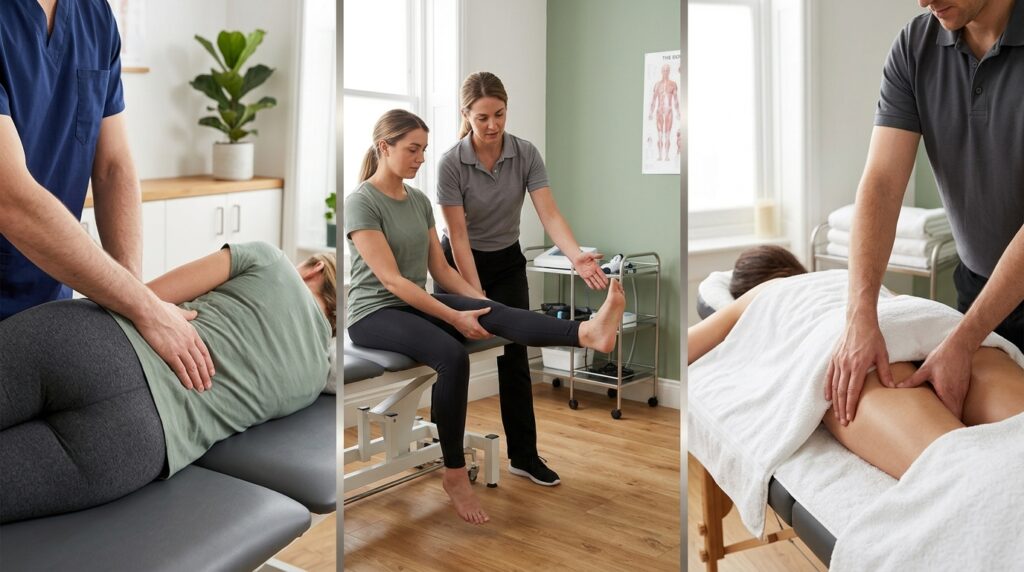
If you have been searching for sciatica treatment near me with pain shooting from your lower back into your leg, the number of options can feel overwhelming. Chiropractors, physiotherapists and massage therapists all treat sciatica, and each takes a different approach. This guide explains what sciatica is, what the clinical guidelines recommend, how each profession treats it, and how to choose the right starting point for your symptoms.
What Is Sciatica?
Sciatica is not a diagnosis in itself. It describes pain, tingling, numbness or weakness caused by irritation of one or more of the nerve roots that form the sciatic nerve. These roots leave the lower spine and join to run through the buttock and down the back of the leg.
Typical symptoms include:
- Sharp, burning or electric pain in the buttock and down the back of one leg
- Pins and needles or numbness in the calf, foot or toes
- Leg pain that is worse than any back pain
- Pain that increases when coughing, sneezing or sitting for long periods
- Weakness when lifting the foot or standing on tiptoe
Common Causes
- Disc herniation. A slipped or herniated disc is the most common cause, with disc material pressing on or inflaming a nerve root.
- Spinal stenosis. Narrowing of the spaces around the nerves, more common after 50, often causing leg pain when walking that eases on sitting.
- Spondylolisthesis. One vertebra slipping forward on another and narrowing the nerve pathway.
- Deep buttock muscle tension. Tight hip muscles such as the piriformis can irritate the sciatic nerve as it passes through the buttock.
- Pregnancy. Postural changes and ligament laxity mean sciatica in pregnancy is common, particularly in the later stages.
You may also see the term sciatic neuritis, which refers to irritation or inflammation of the nerve itself.
Sciatica vs Ordinary Back Pain
Most lower back pain stays in the back or spreads only as far as the buttock or thigh. Sciatica is different: the leg pain usually dominates and often travels below the knee, sometimes with numbness or weakness. This distinction matters because nerve-related pain is treated differently from a simple muscle or joint strain.
Red Flags: When to Seek Urgent Help
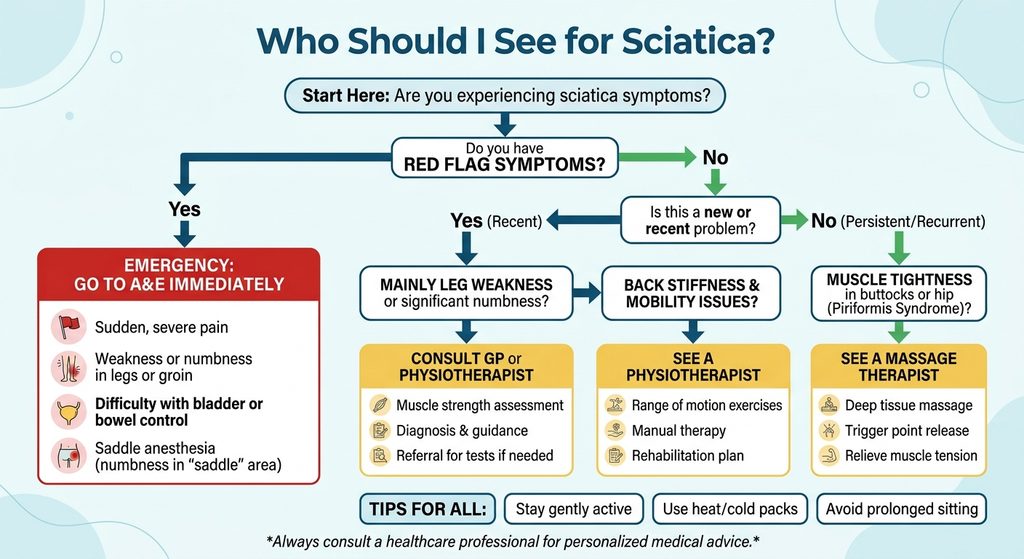
Rarely, sciatica signals a serious problem called cauda equina syndrome. The NHS sciatica guidance advises going to A&E or calling 999 if you have:
- Sciatica in both legs
- Severe or worsening numbness or weakness in both legs
- Numbness around the genitals or back passage
- New difficulty passing urine or loss of bladder or bowel control
These symptoms need emergency hospital assessment, not a clinic appointment.
What the Guidelines Say About Sciatica Treatment
The NICE guideline on low back pain and sciatica recommends exercise as a core part of treatment. It also supports manual therapy, including spinal manipulation, mobilisation and soft tissue techniques such as massage, but only as part of a package that includes exercise. In other words, no single hands-on treatment is recommended on its own.
That principle shapes the comparison below. The question is not which profession is “best” in general, but which approach fits your symptoms and stage of recovery, and how well each one combines with active rehabilitation.
Chiropractic for Sciatica
How a Chiropractor Assesses Sciatica
A chiropractor takes a detailed history and carries out orthopaedic and neurological tests, checking reflexes, sensation, strength and how the nerve responds to tension. The aim is to identify which nerve root is involved, what is irritating it and whether imaging or onward referral is needed.
Treatment Techniques
Chiropractic treatment for sciatica typically includes:
- Spinal manipulation and gentle mobilisation to improve movement in stiff spinal segments
- Pelvic and sacroiliac joint techniques
- Soft tissue work and trigger point therapy for the lower back and buttock muscles
- Dry needling where muscle tension is contributing
- Nerve mobilisation exercises and postural advice
For acute disc-related sciatica, techniques are adapted to be gentle, and forceful manipulation directly at an irritated level is usually avoided.
Who It Suits Best
People searching for a sciatica chiropractor near me are often dealing with sciatica linked to spinal stiffness, pelvic or sacroiliac problems, or recurrent episodes where joint mobility is a recurring factor. Chiropractic also suits people who want a structured plan combining hands-on care with home exercises. If you are deciding between professions, our article on whether to see an osteopath or chiropractor covers the overlap.
Physiotherapy for Sciatica
Assessment and Treatment
Physiotherapy for sciatica starts with a similar assessment of movement, strength and nerve function. Treatment tends to place more weight on graded exercise and rehabilitation, including:
- Directional preference exercises, finding movements that centralise or ease leg pain
- Nerve gliding to restore nerve mobility
- Core, hip and leg strengthening
- Graded return to walking, sitting, lifting and sport
- Manual therapy and mobilisation where helpful
Who It Suits Best
Physiotherapy is a strong fit if you have muscle weakness, have lost confidence in movement, are recovering after spinal surgery, or need a step-by-step return to sport or physically demanding work. It is also well suited to longer-standing sciatica where deconditioning has set in.
Massage for Sciatica
What Massage Can and Cannot Do
Massage can ease muscle spasm in the lower back, buttock and hamstrings, reduce protective guarding and improve comfort, sleep and mobility. A Cochrane review of massage for low back pain found it may offer short-term pain relief, although the quality of evidence was low and long-term benefits were not shown.
Massage cannot take pressure off a nerve root caused by a disc herniation or stenosis. When the nerve itself is the main source of pain, massage is best used alongside treatment from a chiropractor or physiotherapist.
Who It Suits Best
Massage suits people whose pain has a strong muscular component, such as deep buttock tightness, or who want relief from secondary muscle tension while other treatment addresses the cause. Our sciatica massage near me options include deep tissue, sports and pregnancy massage.
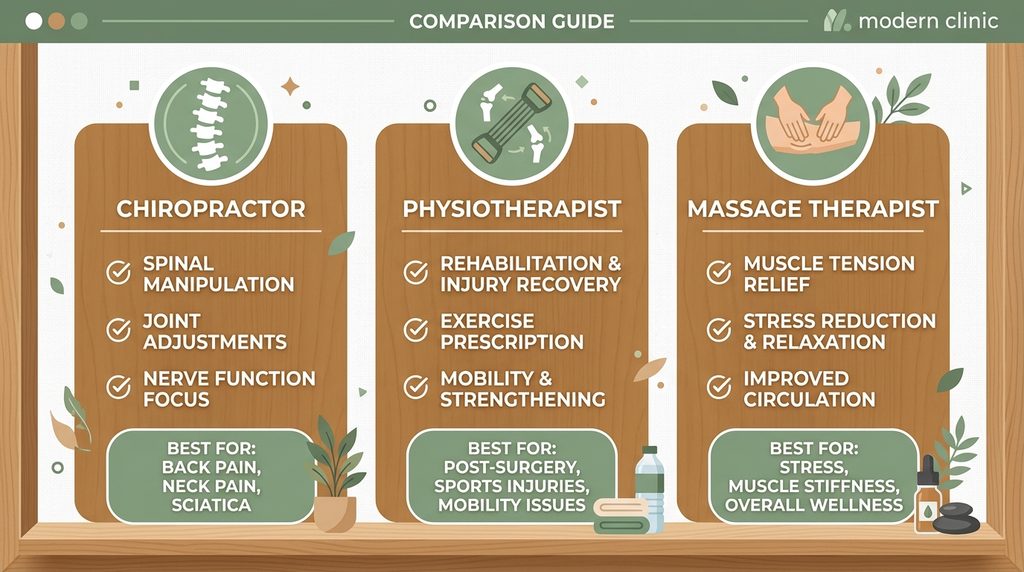
Chiropractor vs Physiotherapist vs Massage: Side-by-Side Comparison
| Factor | Chiropractor | Physiotherapist | Massage Therapist |
|---|---|---|---|
| Main focus | Spinal and pelvic joint function, nerve irritation | Movement, strength and rehabilitation | Muscle tension and soft tissue |
| Diagnosis | Yes, including neurological testing | Yes, including neurological testing | No, works from a referral or known diagnosis |
| Hands-on treatment | Manipulation, mobilisation, soft tissue | Mobilisation, soft tissue | Deep tissue and sports massage |
| Exercise programme | Yes | Yes, usually more extensive | Basic stretching advice |
| Can refer for imaging | Yes, when clinically indicated | Yes, when clinically indicated | No |
| Regulated by | General Chiropractic Council | Health and Care Professions Council | Voluntary bodies |
| Best for | Joint-driven and recurrent sciatica | Weakness, rehab, return to activity | Muscular tension, comfort, recovery support |
Which Helps Most? Matching Treatment to Your Symptoms
| Your Situation | Best Starting Point | Helpful Addition |
|---|---|---|
| New leg pain with back stiffness | Chiropractor | Gentle massage once acute pain settles |
| Leg weakness or loss of strength | Physiotherapist | Chiropractic mobilisation |
| Deep buttock pain without numbness | Massage or chiropractor | Hip strengthening exercises |
| Pain after spinal surgery | Physiotherapist | Massage for muscle tension |
| Recurrent episodes over years | Chiropractor or physiotherapist | Ongoing exercise and maintenance |
| Sciatica during pregnancy | Chiropractor trained in prenatal care | Pregnancy massage |
| Red flag symptoms | A&E or 999 | Not suitable for clinic treatment |
For most people, the answer is not one profession but a combination. Clinical guidelines, research and our own experience all point the same way: hands-on care to reduce pain and restore movement, followed by exercise to make the improvement last.
What to Expect at Your First Appointment
- History. When the pain started, what eases or worsens it, your work and activity levels, and any red flag symptoms.
- Examination. Posture, spinal movement, nerve tension tests, reflexes, strength and sensation.
- Diagnosis and plan. A clear explanation of what is causing your symptoms and how long recovery is likely to take.
- First treatment. Usually started in the same visit if appropriate.
- Home programme. Exercises and practical advice on sitting, sleeping and staying active.
If your examination suggests significant nerve compression, progressive weakness or another cause that needs investigation, we will advise on imaging or refer you to your GP or a specialist.
Case Study: City Commuter With Disc-Related Sciatica (Illustrative)
This is a composite example based on presentations commonly seen in our clinics, not a single identifiable patient.
Presentation: A 46-year-old accountant developed lower back pain after a weekend of gardening, followed a week later by burning pain down the left leg to the outer foot. Sitting on the train and at a desk made it worse, and sleep was disturbed.
Assessment findings:
- Positive nerve tension test on the left
- Slightly reduced ankle reflex and mild numbness on the outer foot
- Pain eased with standing and gentle backward bending
- No red flag symptoms
Plan: Gentle chiropractic mobilisation and soft tissue work, directional preference exercises, nerve glides, a standing break every 30 minutes at work, and deep tissue massage to the buttock and hamstring from week three.
Outcome: Leg pain retreated towards the buttock within two weeks, a positive sign. By week eight the patient was sitting through full working days with only occasional mild back stiffness, and continued a home strengthening routine.
Self-Care Tips Between Sessions
- Keep moving. Gentle walking usually helps more than bed rest.
- Break up sitting. Stand and move every 30 to 45 minutes.
- Use heat. A warm pack on the lower back or buttock can ease muscle spasm.
- Follow your exercise plan. Small, regular sessions work better than occasional long ones.
- Avoid aggravating positions. Slumped sitting and heavy bending often irritate disc-related sciatica.
- Question myths. Many common back pain myths, such as needing complete rest, can slow recovery.
Private Sciatica Treatment in London
NHS physiotherapy is available, but waiting times can be long, which is why many people choose private sciatica physiotherapy in London instead. Private sciatica treatment gives you faster access to assessment and care when pain is affecting work and sleep, and many private health insurance policies cover it.
Our sciatica treatment London service is available at two clinics. At Canary Wharf, close to West India Quay DLR and Canary Wharf station, you can see a chiropractor, physiotherapist or massage therapist under one roof. At Monument, on St Mary at Hill near Monument and Bank stations, our chiropractors treat sciatica for City workers. Patients searching for a sciatica physiotherapist Monument can be assessed by a chiropractor at Monument or travel a short DLR journey from Bank to see a physiotherapist at Canary Wharf.
Book a Sciatica Assessment
Whether you are looking for a chiropractor, physiotherapist or massage therapist for sciatica, our team will assess your symptoms and recommend the right combination of care.
Phone: 020 7531 4444 Email: info@thisislondonwellness.com
London Wellness Canary Wharf Port East Building, 14 Hertsmere Rd, London E14 4AF, United Kingdom
London Wellness Monument The Light Centre, 36 St Mary at Hill, London EC3R 8DU, United Kingdom
Frequently Asked Questions
-
What is the best sciatica treatment?
The best sciatica treatment depends on what is irritating the nerve. Clinical guidelines recommend exercise as the foundation, supported by manual therapy such as spinal manipulation, mobilisation or massage as part of a combined package. Most people improve within weeks to a few months with the right plan. A thorough assessment identifies the cause, rules out serious problems and helps decide whether chiropractic, physiotherapy, massage or a mix of these will help most.
-
Should I see a chiropractor or physiotherapist for sciatica?
Both chiropractors and physiotherapists are regulated professionals who can assess and treat sciatica. A chiropractor may suit you if back stiffness, pelvic problems or recurrent episodes are prominent. A physiotherapist may suit you if you have leg weakness, are recovering from surgery or need a structured return to sport. Many people benefit from both. A first assessment will help confirm which approach fits your symptoms best.
-
Can massage help sciatica?
Massage can help ease the muscle spasm and tension that often accompany sciatica, particularly in the lower back, buttock and hamstrings. It can improve comfort, sleep and mobility in the short term. However, massage cannot relieve pressure on a nerve root from a disc or narrowing in the spine, so it works best alongside chiropractic or physiotherapy treatment that addresses the underlying cause of the nerve irritation.
-
How long does sciatica take to heal with treatment?
Many people notice improvement within two to six weeks of starting treatment, and most sciatica settles within a few months. Recovery depends on the cause, how long symptoms have been present, your general health and how consistently you follow your exercise plan. Disc-related sciatica often improves steadily as the irritated nerve calms down. Your clinician will review your progress regularly and adjust the plan if recovery stalls.
-
When is sciatica an emergency?
Sciatica becomes an emergency if you develop symptoms in both legs, worsening weakness or numbness in both legs, numbness around the genitals or back passage, or new difficulty controlling your bladder or bowels. These can signal cauda equina syndrome, which needs urgent hospital treatment. Go to A&E or call 999 immediately rather than booking a clinic appointment, do not drive yourself to hospital, and take a list of any medicines you use.
-
Where can I find sciatica treatment near me in London?
London Wellness treats sciatica at two City and Docklands clinics. Our Canary Wharf clinic in the Port East Building offers chiropractic, physiotherapy and massage under one roof. Our Monument clinic on St Mary at Hill offers chiropractic care for sciatica, convenient for Bank, Tower Hill and London Bridge. Call 020 7531 4444 or email info@thisislondonwellness.com to book a full sciatica assessment at whichever location suits you best.
Sciatica can stop you in your tracks, but it rarely stops you for good. The right assessment and the right mix of care get most people moving freely again.