

Canary Wharf runs on long hours, tight deadlines and a great deal of time at a desk, all of which are hard on the human spine. So when your back or neck finally forces the issue, a search for a chiropractor near Canary Wharf can throw up a long list of options, and not all of them are equal. Before you book the first name that appears, it pays to know what actually separates a good chiropractor from an average one. If you are weighing up your local wellness centre near me against the rest, here is a practical checklist to work through.
Why Where You Get Treated Matters in Canary Wharf
The typical Canary Wharf professional spends hours hunched over a laptop, commutes in a compressed posture, and squeezes exercise into the edges of the day. Over time that adds up to tight hips, stiff necks and the familiar ache between the shoulder blades. Choosing care close to where you work means you can fit appointments around meetings rather than sacrificing a whole evening, and it makes it far easier to stick with a treatment plan long enough to actually feel the benefit. Convenience is not a luxury here, it is often the difference between finishing your care and quietly giving up on it.
1. Make Sure They Are Registered With the GCC
This is the one point that is not negotiable. In the UK, “chiropractor” is a legally protected title, and anyone using it must be registered with the General Chiropractic Council. It is a criminal offence to practise as a chiropractor without that registration. The GCC maintains a public register you can search by name, so you can verify anyone before you book. Registration confirms they hold an approved qualification and are held to national standards of safety and conduct. If you cannot confirm a practitioner on the register, look elsewhere.
2. Check Their Qualifications and Experience
Beyond the baseline of registration, experience is what you are really paying for. UK chiropractors complete a degree-level programme that typically runs for four to five years, combining anatomy, diagnosis and hands-on clinical training. Ask how long they have been practising and whether they have a particular area of focus.
Some chiropractors pursue additional training in areas such as sports, pregnancy or pain management. The Royal College of Chiropractors recognises practitioners who meet the requirements of its specialist groups, which can be a useful marker if your needs are specific. A newly qualified chiropractor is not a bad choice, but matching their experience to your problem is sensible.
3. Look at the Conditions They Treat
A good clinic will be clear about what chiropractic can and cannot help with. Most commonly, chiropractors treat back pain, neck pain, sciatica and certain types of headache, along with the posture-related strain that builds up from desk work. National clinical guidance from NICE recognises manual therapy as one option within a wider plan for low back pain and sciatica, which is worth knowing when you weigh up your choices.
You can read more about what the treatment itself involves on the chiropractic care service page. The important thing is that the practitioner is honest about your likely outcome rather than promising to fix everything.
It also helps to pick someone who regularly sees the kind of problem you have. In a district full of desk-based professionals, a great deal of what a local chiropractor treats is postural: rounded shoulders, a stiff mid-back, tension headaches and the lower-back ache that comes from sitting for nine hours straight. A practitioner who works with these patterns every day will recognise them quickly and know how to address the root cause rather than just easing the symptom for a day or two.
4. Understand How They Assess Before They Treat
Be wary of anyone who reaches for an adjustment before they understand your problem. A careful chiropractor starts with a proper consultation: your health history, your lifestyle, how the pain behaves, and a physical examination of how your spine and joints move. Only then should they explain their findings and propose a plan.
That first assessment is one of the clearest quality signals you will get. It shows the practitioner is diagnosing you as an individual rather than applying the same routine to everyone who walks in. If a first appointment feels rushed or skips the questions, treat that as a warning sign.
5. Consider a Multidisciplinary Clinic
Back and neck problems rarely sit in a single, tidy box. Sometimes an adjustment is exactly what you need, and sometimes the real fix involves strengthening, soft-tissue work or a longer rehabilitation plan. Clinics that bring chiropractic, physiotherapy, massage and other services together under one roof can hand you between practitioners without you starting from scratch each time.
For busy professionals, this joined-up approach saves time and avoids the frustration of being bounced between unconnected clinics. When your care team can talk to each other about your case, your recovery tends to be smoother and better coordinated.
It is also a useful signal about how a clinic thinks. A practice that offers complementary services is usually less wedded to a single technique and more focused on getting you the right result, even when that means handing you to a colleague. If your back pain turns out to need strengthening work as much as adjustment, being able to move straight into physiotherapy or sports massage under the same roof keeps your momentum going rather than sending you back to square one.
6. Chiropractor, Osteopath or Physiotherapist? Know the Difference
Part of choosing well is understanding who does what, because the roles genuinely overlap. This quick comparison helps you see where each fits.
| Practitioner | Typical focus | Common approach | UK regulator |
|---|---|---|---|
| Chiropractor | Spine, joints and the nervous system | Hands-on adjustments and manipulation | General Chiropractic Council (GCC) |
| Osteopath | Whole-body musculoskeletal balance | Manipulation, stretching and soft-tissue work | General Osteopathic Council (GOsC) |
| Physiotherapist | Movement, rehabilitation and recovery | Exercise prescription and manual therapy | Health and Care Professions Council (HCPC) |
If you are torn between the first two, it is worth reading up on the difference between a chiropractor and an osteopath before you decide, since the right pick often comes down to your specific problem and how you prefer to be treated.
7. Read Reviews and Look for Real Results
Genuine patient feedback tells you what a website cannot. Look for reviews that describe specific problems and outcomes rather than vague praise, and pay attention to how a clinic responds to less glowing comments. Consistent, detailed positive reviews across a decent number of patients are a strong sign of reliable care. Testimonials that mention long-term results, not just a pleasant single visit, are especially telling.
Be a little sceptical of a handful of five-star ratings with no detail, and look instead for a track record built up steadily over years. Reviews that mention the same practitioner by name, describe a clear before-and-after, or note how a stubborn problem was finally resolved carry far more weight than generic praise. Word of mouth from colleagues who work nearby can be just as valuable, since they are judging the same clinics on the same practical criteria you care about.
8. Weigh Up Convenience and Access
Finally, be honest about the practical side. The best chiropractor in the world is no use to you if the clinic is a trek from the office or never has an appointment when you can attend. Look for somewhere close to the station, with straightforward online booking and slots that fit around a working day.
If you are based in the district itself, choosing a chiropractor in Canary Wharf rather than travelling across town removes one of the biggest reasons people abandon treatment early. A short walk from your desk means you can keep regular appointments even during a demanding week, and that consistency is what turns a promising start into a lasting result. When your treatment fits your life, you are far more likely to complete the plan and get the outcome you came for.
Making Your Decision
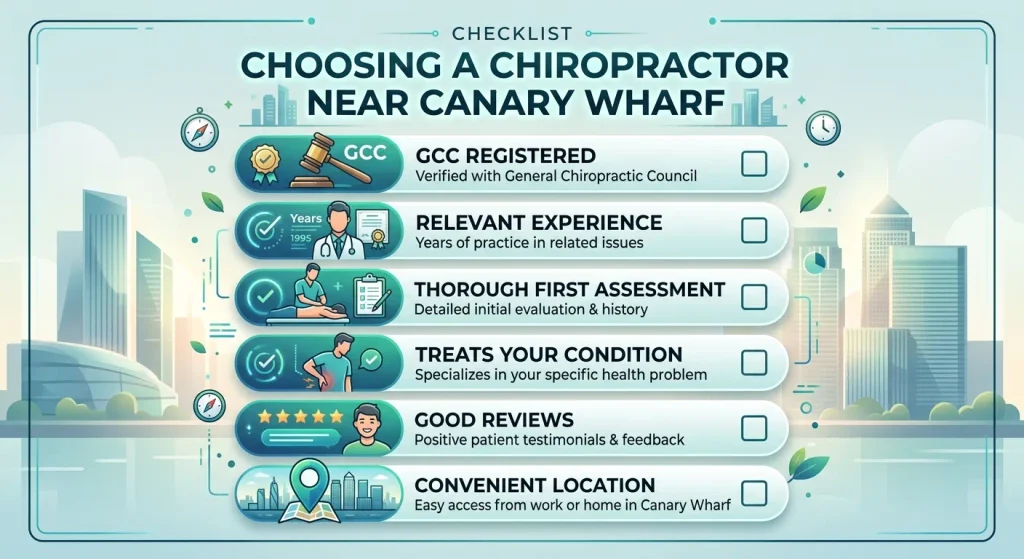
Put simply, start with GCC registration as your filter, then judge on experience, honest assessment, the conditions they treat, real reviews and everyday convenience. Work through those and the long list of options near Canary Wharf quickly narrows to the few clinics genuinely worth your time.
If you would like to book an assessment, you can reach our team by phone on 020 7531 4444 or by email at info@thisislondonwellness.com. Appointments are available at:
- Canary Wharf: Port East Building, 14 Hertsmere Rd, London E14 4AF
- Monument: The Light Centre, 36 St Mary at Hill, London EC3R 8DU
Frequently Asked Questions
-
Do I need a referral to see a chiropractor near Canary Wharf?
No. Chiropractic is usually accessed privately in the UK, so you can book directly without a GP referral and be seen quickly, which suits busy Canary Wharf schedules. If you have private health insurance, it is worth checking whether chiropractic is covered and whether your insurer needs a referral first. For NHS routes, availability is limited and a referral is typically required, so most people simply self-refer to a private clinic.
-
Is a chiropractor better than an osteopath or physiotherapist?
Not better, just different. Chiropractors focus heavily on the spine and joints using hands-on adjustments, osteopaths take a broader whole-body approach, and physiotherapists lean on exercise and rehabilitation. The right choice depends on your problem and how you like to be treated. For many back and neck issues there is real overlap, and a good multidisciplinary clinic will guide you towards whichever practitioner fits your needs rather than forcing a single approach on everyone.
-
How do I know if a chiropractor is properly qualified?
In the UK, chiropractor is a protected title, so anyone using it must be registered with the General Chiropractic Council. That registration confirms they hold an approved degree and meet national standards, and you can search the register by name before booking. Beyond that, look at their years of experience, any special-interest qualifications and genuine patient reviews. Registration is the non-negotiable baseline, while experience and reputation help you choose between qualified practitioners.
-
What conditions can a chiropractor help with?
Chiropractors most commonly help with back pain, neck pain, sciatica and certain headaches, along with joint problems and posture-related strain from desk work. They assess how your spine and joints move, then use hands-on techniques and advice to reduce pain and improve function. They will also flag anything that needs a different specialist. If your symptoms are severe, sudden or unusual, a thorough assessment first ensures you get the right care rather than assumptions.
-
What happens at a first chiropractic appointment?
Your first visit is mostly assessment, not rushed treatment. Expect questions about your health history, lifestyle and symptoms, followed by a physical examination of how you move. From there, the chiropractor explains what they have found and proposes a tailored plan, and treatment may begin in the same session if appropriate. A careful practitioner treats only after understanding your problem, so a thorough first appointment is a good sign rather than a delay.
-
How do I find the best chiropractor near me in Canary Wharf?
Start with GCC registration, then weigh experience, the conditions they treat and honest patient reviews. Convenience matters too when you work locally, so a clinic close to the station with flexible booking is much easier to stick with. Multidisciplinary clinics that also offer physiotherapy and massage can help if your problem needs more than adjustments. Judge on qualifications and fit rather than proximity alone, then book an assessment to see how they work.
The right chiropractor is worth the few minutes it takes to check the essentials, so run through the list, trust the fundamentals over the marketing, and choose the clinic that fits both your problem and your working week.