
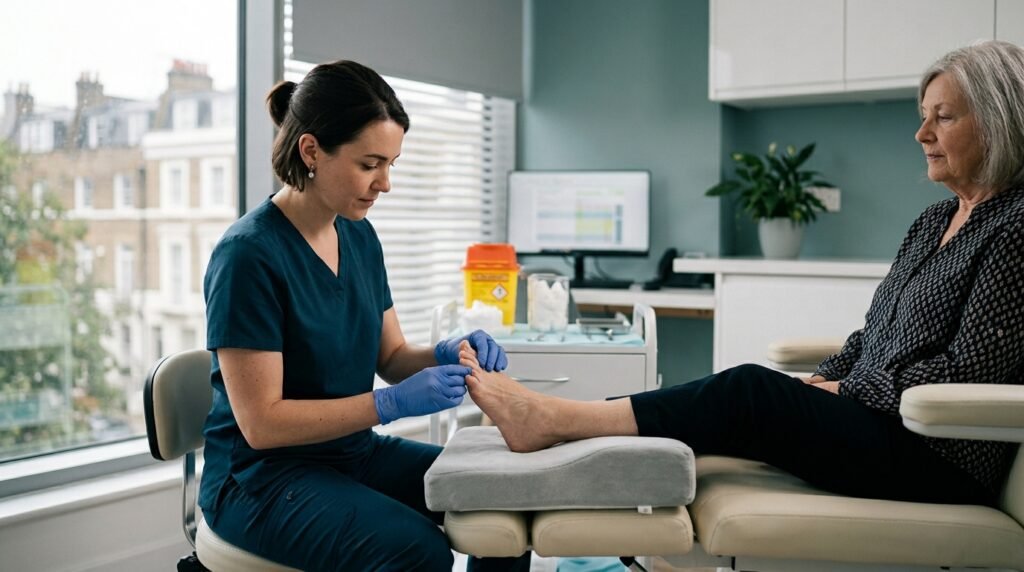
If you have ever tried to book an appointment for sore feet, you have probably seen both words used almost interchangeably and wondered whether a chiropodist and a podiatrist are actually two different things. It is one of the most common questions we hear from people searching for a podiatrist near me. The short answer is that they are the same profession. The longer answer, which is genuinely worth understanding before you book, explains why two names exist, what these foot specialists really do, and how to check that whoever treats your feet is properly qualified.
The Short Answer: They Are the Same Profession
Let us clear up the confusion straight away. In the UK, “chiropodist” and “podiatrist” describe exactly the same job. There is no hidden hierarchy, no extra qualification hiding behind one title, and nothing a chiropodist can do that a podiatrist cannot. Both are trained to assess, diagnose and treat problems affecting the feet, ankles and lower limbs.
The reason two words survive is simply history. “Chiropodist” is the older British term, and plenty of people, especially those who have been having their feet cared for over many years, still use it out of habit. “Podiatrist” is the modern, internationally recognised name for the same specialist. If a clinic advertises one and you were looking for the other, you are in the right place either way.
Where the Two Terms Came From
The story behind the names helps explain why the profession still carries both.
Why “Chiropodist” Was the Original UK Term
The word chiropodist has been used in Britain for more than a century. The first professional body of foot practitioners in Europe was founded here in 1912, and for decades the profession organised itself around the word “chiropody”. Generations of patients grew up asking their GP to refer them to the chiropodist, so the term became deeply familiar.
Why “Podiatrist” Became the Modern Standard
Over time the profession moved towards “podiatrist” to align with international standards and to better reflect the clinical, medical nature of the work. The UK’s leading professional body eventually became the Royal College of Podiatry, cementing the modern term. In some countries, including the United States, “chiropodist” is now considered outdated altogether. The change is about language and consistency, not about the level of care you receive.
What a Podiatrist (or Chiropodist) Actually Treats
Foot care goes far beyond trimming nails. A good foot specialist looks at your feet in the context of how you stand, walk and move, because problems lower down often have knock-on effects higher up. Here is what falls within their scope.
Everyday Foot and Nail Care
Routine care covers thickened or difficult toenails, hard skin and general foot maintenance. This is the bread and butter of the profession and the reason many people book in the first place. It matters more than it sounds, because small, neglected issues have a habit of becoming painful ones.
Skin Conditions of the Feet
Corns, calluses, verrucae and fungal nail infections are all treated here. These are common, often stubborn, and rarely resolve on their own. A trained practitioner can remove the underlying cause rather than just easing the symptom, which is why home remedies so often disappoint.
Ingrown Toenails and Nail Surgery
An ingrown toenail can go from mildly annoying to genuinely painful and infected. Foot specialists assess whether the nail can be managed conservatively or whether minor nail surgery under local anaesthetic is the better long-term solution. Done properly, it offers lasting relief rather than a temporary fix.
Biomechanics, Gait and Orthotics
This is the part people underestimate. The way your foot strikes the ground affects your ankles, knees, hips and lower back. Poor foot mechanics can send strain right up the kinetic chain, which is why foot posture is often connected to the muscles of the hip and beyond. A biomechanical assessment looks at how you move and may lead to custom insoles, or orthotics, to correct the problem at its source.
Diabetic and High-Risk Foot Care
For people with diabetes or poor circulation, feet need careful monitoring. Reduced sensation and slower healing turn small problems into serious ones, so regular specialist checks are an important part of staying well. This is skilled, preventative medical care, not a cosmetic add-on.
Chiropodist vs Podiatrist vs Physiotherapist: Who Should You See?
Because the titles overlap, it helps to see where a foot specialist sits alongside other professionals you might consider. Use this as a quick guide to who does what.
| Professional | Best for | Registration |
|---|---|---|
| Podiatrist / Chiropodist | Skin and nail problems, ingrown toenails, corns, calluses, verrucae, nail surgery, gait and biomechanical issues, diabetic foot care | HCPC (protected title) |
| Physiotherapist | Rehabilitation of muscles, joints and soft tissue after injury, restoring movement and strength | HCPC |
| Orthopaedic surgeon | Structural foot and ankle problems that may require surgery | GMC |
| GP | First point of contact for general concerns and onward referrals | GMC |
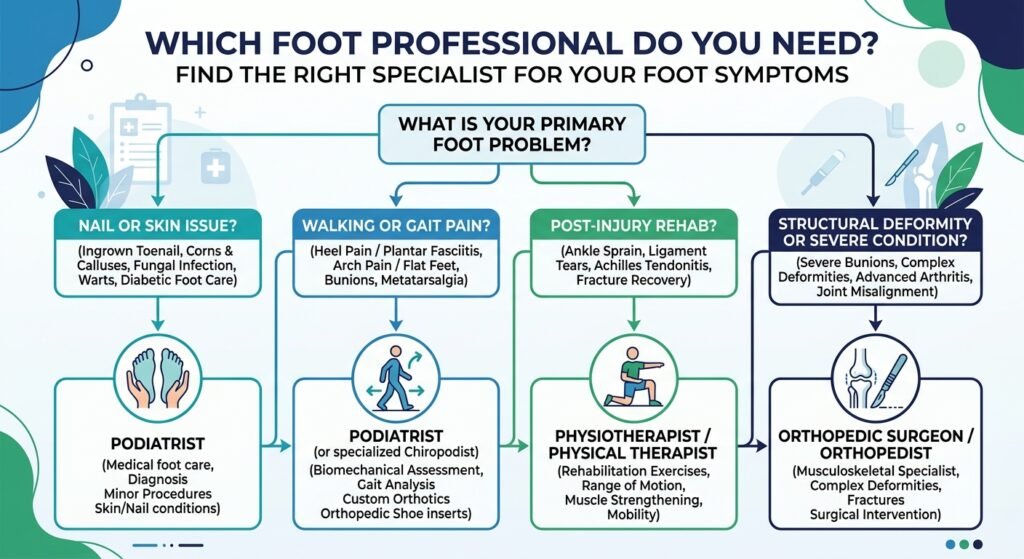
For most everyday foot and nail concerns, and for gait or biomechanical pain, a podiatrist is the right starting point. If your problem is clearly about rehabilitating a muscle or joint after an injury, physiotherapy may be more appropriate, and the two often work together.
How to Check Your Foot Specialist Is Properly Qualified
This is where the “chiropodist vs podiatrist” question really matters, and it has nothing to do with the title itself.
In the UK, both “podiatrist” and “chiropodist” are legally protected titles. That means a person can only use them if they are registered with the Health and Care Professions Council (HCPC). Registration confirms that they have completed an approved degree-level qualification and meet national standards of practice. Before any appointment, you are entitled to check that your practitioner appears on that register.
You can also look for membership of a recognised professional body such as the Royal College of Podiatry, which supports ongoing training and standards across the profession. The NHS provides helpful background on what to expect from foot health services if you want to understand the clinical side further. The takeaway is simple: judge the person by their HCPC registration and experience, not by whether their sign says chiropodist or podiatrist.
What to Expect at Your First Foot Appointment
A first visit is mostly about understanding you and your feet, not rushing into treatment. Expect a conversation about your medical history, any medication you take, and what has been bothering you. Your practitioner will examine the skin, nails and structure of your feet, and often check circulation and sensation, particularly if you have a condition such as diabetes.
From there you will get a clear explanation of what is going on and a plan tailored to you. Many common issues, such as hard skin, corns or a straightforward nail problem, can be treated in the same session. If you have been putting off dealing with foot pain, seeing a podiatrist in Canary Wharf or another convenient London location is usually far quicker and simpler than people expect. Our foot care is delivered by a specialist chiropody and podiatry team, so you are seen by someone who does this work day in, day out.
A Representative Case: From Painful Ingrown Toenail to Back on His Feet
To show how this works in practice, here is a representative example of a common case we see (an illustrative scenario rather than a named individual).
James, an office worker in his thirties, had been living with a sore big toe for months. He assumed it would settle on its own, so he trimmed the nail aggressively and hoped for the best. Instead it became red, swollen and painful enough to make his walk to work uncomfortable. By the time he searched for a foot specialist near me, the nail was infected along one edge.
At assessment, the issue was a classic ingrown toenail. Rather than repeatedly cutting into the nail, which tends to make matters worse, the recommended solution was a minor nail procedure under local anaesthetic to remove the offending edge and prevent regrowth in that spot. Within a couple of visits he was comfortable again and back to walking and exercising normally. The lesson is one we see constantly: small foot problems are far easier to fix early than late.
Book With a Qualified Foot Specialist in London
If your feet need attention, you do not need to decode the difference between the titles. You just need someone qualified, registered and experienced.
You can reach our team by phone on +442075314444 or by email at info@thisislondonwellness.com. Foot care appointments are available at:
- Canary Wharf: Port East Building, 14 Hertsmere Rd, London E14 4AF
- Monument: The Light Centre, 36 St Mary at Hill, London EC3R 8DU
Frequently Asked Questions
-
Is there any difference between a chiropodist and a podiatrist in the UK?
No, there is no clinical difference. In the UK the two words describe the same profession, with the same training and the same scope of practice. “Chiropodist” is the older British term and “podiatrist” is the modern, internationally recognised one. Both titles are legally protected and require HCPC registration, so a practitioner using either name has met the same national standards for treating feet and lower limbs.
-
Is a podiatrist a doctor?
A podiatrist is not usually a medical doctor in the same sense as a GP, but they are a highly trained, degree-qualified healthcare professional who specialises solely in the foot, ankle and lower limb. In the UK they complete an approved podiatry degree and register with the HCPC. Some go on to advanced practice, including minor surgery. For foot and nail problems, they are the dedicated specialist rather than a generalist.
-
Do I need a GP referral to see a podiatrist?
For private foot care you do not usually need a GP referral. You can book directly with a registered podiatrist or chiropodist and be assessed straight away, which is why many people choose private clinics for speed and convenience. Referrals are more common within NHS services, where eligibility is based on clinical need. If you are unsure whether your issue is urgent, contacting the clinic directly is the quickest way to get guidance.
-
What does a podiatrist do that a chiropodist doesn’t?
Nothing, because they are the same profession. Any difference you notice between two practitioners comes down to their individual experience, special interests and the equipment their clinic offers, not the title on the door. One podiatrist might focus more on biomechanics and orthotics while another does a lot of nail surgery. The word they use, chiropodist or podiatrist, tells you nothing about that. Their HCPC registration and track record do.
-
Should I see a podiatrist or a chiropodist for an ingrown toenail?
Either, because they are the same. An ingrown toenail is a very common reason to see a foot specialist, and a registered podiatrist or chiropodist can assess it, treat any infection and, if needed, perform a minor nail procedure under local anaesthetic for lasting relief. What matters is choosing someone HCPC registered and experienced with nail surgery, not which of the two titles they happen to use in their listing.
-
How do I find a good podiatrist near me?
Start by checking that anyone you consider is registered with the HCPC, since that guarantees approved training and national standards. Look for genuine patient reviews, clear information about the conditions they treat, and convenient clinic locations. In London, searching for a chiropodist or podiatrist near me will bring up local options, but let registration and experience guide your choice rather than distance or title alone.
Your feet carry you through every day, so when they hurt, do not wait for the confusion over names to slow you down: book with a qualified specialist and get moving again.