
If you have been nursing a stubborn, aching heel for months, you have probably reached the point where rest, stretching and new trainers just are not cutting it. Achilles pain is famously persistent, which is exactly why so many people end up searching for shockwave therapy near me once the usual advice runs out. This guide explains what shockwave therapy for Achilles tendon pain actually involves, how it works, what a session feels like, and how to know whether it is the right next step for you.
What Is Achilles Tendon Pain?
The Achilles is the thick tendon connecting your calf muscle to your heel bone, and it takes an enormous load every time you walk, run or push off. When that load outpaces the tendon’s ability to recover, you get Achilles tendinopathy: pain, stiffness and sometimes swelling along the tendon or where it meets the heel.
Two patterns are common. Mid-portion tendinopathy sits a few centimetres above the heel, while insertional tendinopathy sits right at the bone. Both tend to share a telltale sign: stiffness and pain first thing in the morning or after sitting still, which eases as you warm up and then flares again once you stop. You can read a plain-English overview of the condition in the NHS resource on Achilles tendinopathy.
It is not just an athlete’s problem, though runners are especially prone to it. It most often turns up in people between their thirties and fifties, frequently after a sudden jump in activity: a new running plan, a return to sport after time off, or a job that keeps you on hard floors all day.
Why the Achilles Tendon Is So Slow to Heal
Here is the frustrating part. Tendons have a relatively poor blood supply compared with muscle, so they mend slowly. And long-standing Achilles pain is usually less about active inflammation and more about degeneration, meaning the tendon tissue itself has become disorganised and weaker over time.
That is why simply resting often disappoints. Rest calms the symptoms, but it does little to rebuild the tendon, so the pain returns the moment you load it again. Effective treatment has to stimulate the tissue to remodel and strengthen, not just quieten it down. That distinction is the whole reason approaches like shockwave exist, and it is covered well in general NHS guidance on tendonitis.
What Is Shockwave Therapy?
Shockwave therapy, known clinically as extracorporeal shockwave therapy or ESWT, uses high-energy acoustic pulses delivered through the skin by a handheld applicator. It started life in medicine as a way to break up kidney stones and has since become a mainstream, non-invasive option for stubborn musculoskeletal problems. You can explore the treatment in more detail on our shockwave therapy in London service page.
How ESWT Works
The pulses create a controlled mechanical stress in the target tissue. This kick-starts a biological response: increased blood flow to the area, the release of healing signals, and a remodelling process that encourages the tendon to repair itself. In essence, the treatment nudges a stalled healing process back into motion. Growing evidence, summarised in recent research reviews, supports its use across a range of tendon and soft-tissue conditions.
Focused vs Radial Shockwave
You may hear two types mentioned. Focused shockwave concentrates energy at a specific depth, while radial shockwave spreads energy more broadly across the surface. Both are used for tendon problems, and a good clinician will choose based on your presentation rather than a one-size-fits-all setting.
How Shockwave Therapy Helps Achilles Tendon Pain
For the Achilles specifically, shockwave targets exactly the problem described above: a degenerate tendon that has stopped healing on its own. By stimulating local circulation and the body’s repair response, it helps the tissue reorganise and become more tolerant of load. It also appears to interrupt the pain signalling around the tendon, which is why many people notice their symptoms easing over a course of treatment.
Crucially, it tends to be most useful for chronic cases: pain that has been hanging around for three to six months or longer, particularly when rest, exercises and footwear changes have not delivered. It is not usually the first thing to try on a brand new injury, and it works far better as part of a plan than as a standalone fix.
What to Expect During a Shockwave Session
A first visit starts with a proper assessment, because getting the diagnosis right matters more than the machine settings. Your clinician will ask about your history, examine the tendon and check how you move.
The treatment itself is straightforward. A little gel goes onto the skin, and the applicator is pressed against the tendon while it delivers pulses. Each area usually takes only a few minutes. You will feel a rapid tapping sensation that can be mildly uncomfortable where the tendon is most sensitive, but no anaesthetic is needed and you can walk straight out afterwards. Most people have a short course of sessions spaced about a week apart, with your clinician adjusting the plan based on how you respond.
Does It Hurt, and Is It Safe?
Honesty helps here. Shockwave is not painful in the way an injection is, but it is not entirely comfortable either. Expect a strong tapping feeling during treatment and possibly some dull soreness or slight redness for a day or two afterwards, which settles quickly.
Performed by a trained clinician, it has a strong safety record. That said, it is not suitable for everyone. It is generally avoided during pregnancy, over certain implants, in people on blood-thinning medication, and where there is infection or a suspected tendon rupture in the area. This is exactly why a face-to-face assessment comes first, rather than booking a machine.
Shockwave Therapy vs Other Achilles Treatments
Shockwave is one tool among several, and the best results usually come from combining it with loading exercises. Here is how the main options compare.
| Approach | Best for | Notes |
|---|---|---|
| Load management and rest | Early flare-ups | Calms symptoms but rarely rebuilds the tendon on its own |
| Progressive loading exercises | Almost everyone | The evidence-based backbone of recovery; slow but effective |
| Heel lifts or orthotics | Insertional pain, biomechanical issues | Reduces strain while the tendon settles |
| Shockwave therapy (ESWT) | Chronic, stubborn cases | Restarts healing; works best alongside loading |
| Injections | Selected cases | Considered cautiously for tendons; not a first choice |
| Surgery | Rare, last-resort cases | Only after conservative options have been exhausted |
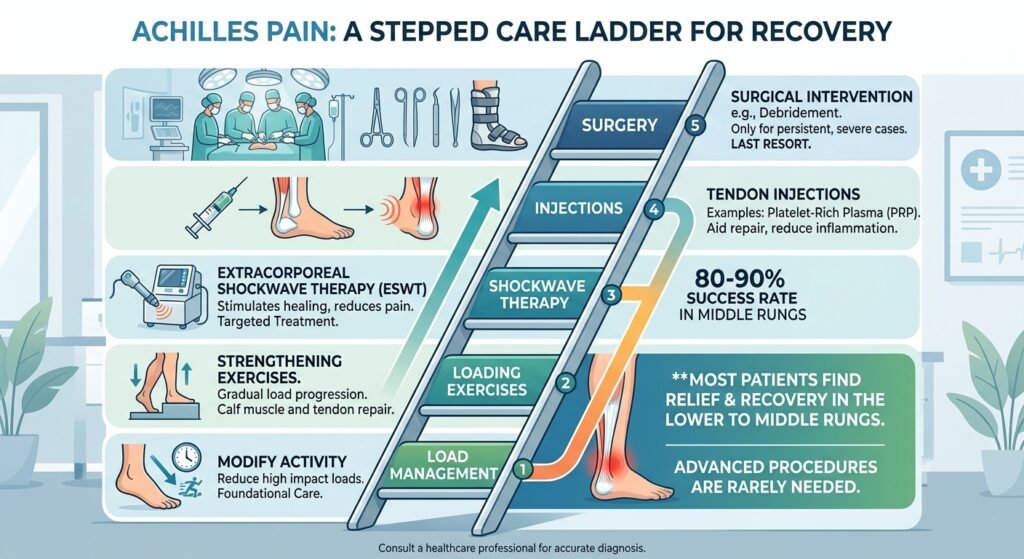
This is where rehab really counts. Pairing shockwave with a structured physiotherapy programme of calf and tendon loading gives the tissue both the stimulus and the strength it needs. Because Achilles tendinopathy is such a common sports injury, treating it well often means addressing the training or movement pattern that triggered it in the first place.
Recovery and Getting Back to Running
Patience is the theme. Tendons respond over weeks and months, not days, so expect gradual gains rather than an overnight switch. Many people feel meaningful improvement across a course of shockwave combined with daily loading work, then continue to build as they reintroduce impact.
Returning to running is best done in stages: rebuild capacity with your rehab exercises first, then layer in walking, easy jogging and, finally, faster or longer efforts. If you are an event runner, the same graded principles that guide returning to running after a marathon apply here, respect the tendon’s timeline and it will reward you.
When to See a Specialist in London
If your Achilles pain has lingered beyond a few weeks, keeps interrupting your activity, or has not budged with rest and stretching, it is worth getting it assessed properly rather than guessing. A specialist can confirm the diagnosis, rule out other causes and build a plan that fits your goals.
One important safety note: if you ever feel a sudden, sharp pain or a snapping sensation in the back of your ankle, sometimes with a popping sound, treat it as a possible tendon rupture and seek urgent medical care through 111 or A&E, not a routine appointment. For everything short of that, a timely assessment saves months of frustration. We offer shockwave therapy in Monument and across our London clinics, so finding expert care near you is straightforward.
Book an Assessment in London
If Achilles pain is holding you back, the first step is a proper assessment with a qualified clinician who can tell you whether shockwave is right for you.
You can reach our team by phone on 020 7531 4444 or by email at info@thisislondonwellness.com. Appointments are available at:
- Canary Wharf: Port East Building, 14 Hertsmere Rd, London E14 4AF
- Monument: The Light Centre, 36 St Mary at Hill, London EC3R 8DU
Frequently Asked Questions
-
Does shockwave therapy really work for Achilles tendon pain?
For long-standing Achilles tendinopathy, shockwave therapy has good supporting evidence, especially when other measures have failed and it is combined with loading exercises. It works by restarting the tendon’s natural repair process rather than just masking symptoms. Results build gradually over a course of sessions rather than instantly. It is not a guaranteed cure for everyone, but for stubborn, chronic cases it is a well-established and worthwhile option to consider.
-
How many shockwave sessions will I need for my Achilles?
Most people have a short course of sessions, typically spaced around a week apart, rather than a single treatment. The exact number depends on how chronic your tendon problem is, how it responds, and whether you are keeping up with your loading exercises alongside it. Your clinician will review progress as you go and adjust the plan, so the course is tailored to you rather than fixed in advance. Improvement usually continues after the sessions finish.
-
Is shockwave therapy for Achilles tendonitis painful?
It is uncomfortable rather than truly painful. During treatment you will feel a strong, rapid tapping sensation over the tendon, which can be more noticeable where the area is tender. No anaesthetic is needed, and the sensitivity eases as the session goes on. Afterwards, some people notice mild soreness or slight redness for a day or two, which settles on its own. Most find it very manageable, particularly given the results it can deliver.
-
How soon can I run after shockwave therapy?
There is no fixed date, because it depends on your tendon and your rehab progress rather than the shockwave alone. The safest approach is a graded return: build strength and capacity with your loading exercises first, then reintroduce walking and easy jogging before faster or longer runs. Rushing back to impact too early is the most common way to undo your progress. Your clinician can give you specific milestones based on how your Achilles is responding.
-
Who should not have shockwave therapy?
Shockwave is not suitable for everyone. It is generally avoided during pregnancy, in people taking blood-thinning medication, over certain implants or areas of infection, and where a tendon rupture is suspected. Some other medical conditions also need caution. This is precisely why a proper assessment comes before any treatment, so a qualified clinician can confirm it is safe and appropriate for you rather than applying it blindly to every case.
-
Where can I get shockwave therapy for Achilles pain near me?
If you live or work in London, look for a clinic where shockwave is delivered by qualified clinicians as part of a full assessment and rehab plan, not just a standalone machine. Checking that the treatment is paired with a proper diagnosis and loading programme matters far more than convenience alone. Our team provides shockwave therapy and Achilles rehabilitation across central and east London locations, so expert care is close to hand.
Achilles pain rewards patience and the right plan, so if rest alone has not worked, get it assessed properly and give your tendon the stimulus it actually needs to heal.